Montclarions Miffed About Real Estate Tax Uses

In November, Today in Montclair wanted to understand and gauge local attitudes towards taxes levied on homeowners.  After letting our real estate tax survey bake in the oven, we’re ready to share the goods with everyone.

The takeaways?  While you’re somewhat resigned to Oakland’s current taxes, you don’t want them increased much without better accountability.  You’re focused on how any tax increases would get spent by the city.  And you’re wrestling with Proposition 13’s legacy, too.
Tax Rate Attitudes

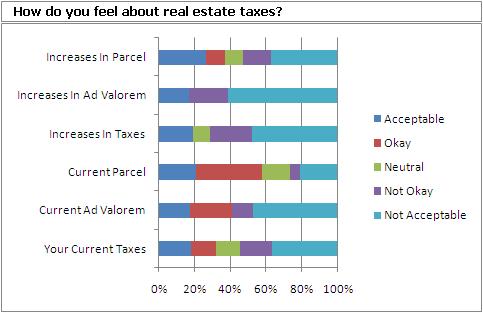
Based on our survey, some 32 percent of Montclarions felt current overall taxes were acceptable/okay and another 14 percent were neutral.  The ad-valorem taxes were viewed similarly, with 42 percent acceptable/okay and no one who was neutral.  Respondents were more positive towards parcel taxes, with 58 percent ticking acceptable/okay and 16 percent who were neutral.

Reactions to tax increases moved slightly south, as expected.  Some 29 percent felt overall increases would be acceptable/okay/neutral, while 71 percent said thumbs-down.  The biggest negatives were due to ad-valorem increases, with a full 83 percent ticking not acceptable or okay.  By contrast, 53 percent said parcel taxes were not acceptable or okay.

We also asked locals how they generally voted for measures which increased homeowner taxes.  These responses tracked consistently with parcel tax viewpoints.  Some 45 percent reported “no, most times” and five percent said “no, always.”  The remaining survey takers said they would accept increases most times/sometimes.

As expected, last summer’s decision to increase city ad-valorem taxes was rather quietly revealed.  These taxes were increased from 1.33 to 1.41 percent – and 36 percent knew, 59 didn’t know, and the rest weren’t sure.

Tax Revenue Uses

We asked a hypothetical question about how tax increases might be used, and Montclarions overwhelmingly wanted more resources directed to hills services:  65 percent ticked acceptable/okay.  This isn’t surprising, as you do hear neighbors complain about safety, infrastructure or park support.

Yet the desire to direct resources wasn’t fully focused on hills services.  Survey takers also believed that resources should be funneled to specific city departments or services, with over 50 percent deeming that acceptable/okay.

The majority of Montclarions didn’t want increases to be unassigned, as 60 percent were against increasing taxes for general city coffers.  However there’s ongoing debate about resource allocations and accountability:

– I do not trust the Oakland city council to make sound financial decisions but I also dislike special assessments for basic city services.  Piece-mealing obscures the reality and the enormity of the city’s spending.

– In general, taxes for a specific purpose do not work in Oakland – this just frees up general fund monies for non-worthwhile endeavors.

– My taxes keep going up and the city’s administration and services keep deteriorating. There is something wrong with this picture.

– OAK has to get its problems under control – the fiscal house is a fiscal sieve – you cannot have examples weekly of how badly the CC [City Council] misspends the precious resource – money and then have the CC going back time after time to require more payments.

– I don’t mind paying extra taxes but I feel the city is grossly mismanaged and any revenue raised goes into a black hole / politicians’ pet projects without any derived benefit to me, the tax payer.

Unfair Taxes Anyway

Many Montclarions were quick to point out Proposition 13’s tax inequities, and the data bears this out.  Based on all respondents reporting, their annual taxes were $9,940 (average) and $9,710 (median) – and ranged from $4,000 to $18,000.

Of course, the more-recent home buyers were taxed far higher than their neighbors.  One hard-hit respondent still took this in stride, declaring “I bought my house 5 years ago and pay more taxes than anyone on my street.  Something that raises my taxes $65 doesn’t bother me, and helps even out the tax load.”

Another survey taker believed we have to create a better tax solution:  “Generally speaking, we pay far too little property taxes compared to other parts of the world.  We need a way to contribute more to our living infrastructure without being too subjected to the wild fluctuation of the home values.”

Based on Today in Montclair’s real estate survey, we can safely say that locals are willing to pay up – far more than we expected.  However what’s done with the tax revenues is a much bigger question, and the City of Oakland will have to work on some real confidence and credibility building there.

More info:  The survey respondents split 64% male and 36% female.  Ages broke down as: under 40 years (23%);  40-49 (41%); and 50-plus (36%).  Everyone owned homes:  under 1 year (5%); 1-2 (9%);  3-4 (18%); 5-9 (18%); 10-14 (27%); 15-19 (9%); and 20-plus (14%).
MOBN Announces 90-Day Plan And General Assembly

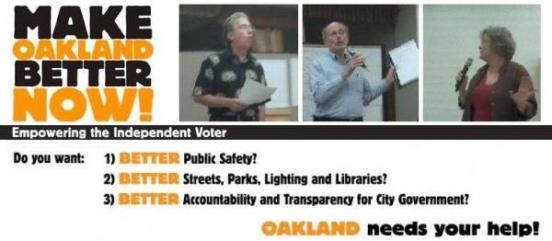
We’re pleased to publish a guest post from Bruce Nye, our concerned neighbor who initiated Make Oakland Better Now!   This grassroots, city-wide effort seeks to “shine a light on mayoral and city council candidates’ positions” in the coming year.  Take it away, Bruce…

Make Oakland Better Now! Announces Its 90-Day Plan And February 21, 2010 General Assembly

by Bruce Nye

Last August, more than 100 Oaklanders met at St. Theresa’s Church to form Make Oakland Better Now!, a grassroots issues and advocacy organization devoted to improving public safety, public works, transparency and accountability in the City of Oakland.

Make Oakland Better Now! was formed by Oakland residents, many of whom hadn’t been activists for a long time and many of whom admitted they hadn’t paid as much attention to Oakland politics as they should have.  But they believed Oakland was a wonderful city that urgently needed to change.  And they were determined to build an organization that would be a force in these three critical areas in the 2010 mayor’s race and beyond.  More specifically, Make Oakland Better Now! is determined to shine a light on mayoral and city council candidates’ positions in these three areas and to monitor improvement after the election.

At our kick-off meeting and in the months afterward, Make Oakland Better Now! assembled a leadership group determined to move this city forward.  This group has been asking questions, listening, reading and developing a sense of Oakland’s recent political history.  They’ve met with this city’s opinion leaders, city officials and knowledgeable people outside of government, trying to cast as wide a net as they can.  The process isn’t over yet, and will, we anticipate, be an ongoing one.  But we are finally ready to move.

The most important thing for you to know right now is this:  our next general assembly will be on Sunday, February 21, 2010 at 3:00 p.m. Please mark your calendars now, and do everything you can to hold the date.  This will be the meeting when our membership adopts positions and sets priorities in the three areas most important to Oakland:  public safety; government transparency/accountability; and public works.  We are working on selecting a centrally located, easily accessible venue, and will be announcing the “where” information very soon.

The leaders of the three committees are in the process of finishing a list of proposed MOBNow! positions and priorities in their areas of interest. That process will be finished by December 28th.  In January, each committee will hold a study group meeting and a committee meeting; we’ll also be announcing the dates, times and places for those meetings before year’s end.  At the study group meetings, we’ll have experts prepared to answer the committee’s questions.  At the committee meeting, we’ll make the final decision on the positions and priorities to recommend to the general assembly.

The next ninety days are going to be important, busy and exciting.  We need as many folks as possible to pitch in and help.  If you’d like to be more involved in any of the three areas (public safety, government transparency/accountability or public works), or in support (events, outreach, publicity, etc.), then e-mail: Oaklanders@makeoaklandbetternow.org.  And there’s always more information available at www.makeoaklandbetternow.org.  Please join us – Oakland needs you.

This guest post from Bruce Nye, one of the founders of Make Oakland Better Now! has been cross-posted at A Better Oakland, our city’s government and politics blog of record.

December 4th Update:  Positions are now getting posted at MOBN! and Oakland Local, and your comments are most welcome there.  (To commune with Montclarions, you may join our social network anytime.)

It Can Happen Anywhere

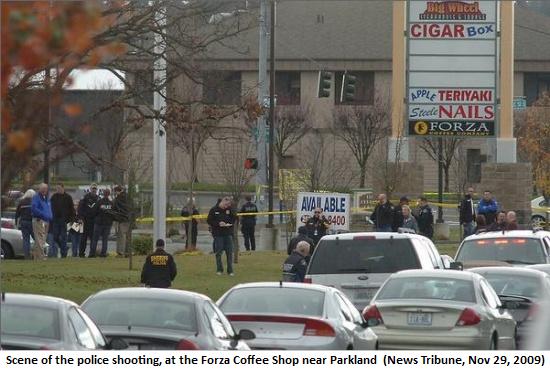
Another four cops, from Lakewood WA, were gunned down a few hours ago.

Because we’re hearing news from Washington State, this ambush occurred at a local coffee shop!  Apparently the shooter ambushed and killed three men and one woman, as they were doing “paperwork” on their laptops.

We feel instant empathy, hearing about the tragedy.  Ed Troyer, from the Pierce County Sheriff’s department, said it was definitely a targeted attack, or “walk in with the specific mindset to shoot police officers.”  The shooter ran away and is still at-large.

Back in Oakland, we’re shaking our heads.  We know, first hand, how it feels when four city officers are gunned down needlessly.  We should definitely reach out and commiserate with folks from the Tacoma area, as their news unfolds.

There’s not much more to share, at this point, than our utter disgust here.  Our society’s become so uncivilized and violent, and this ambush makes no sense.

December 1st Update:  The suspect was shot and killed, by Seattle police.

Don’t Use Your Fireplaces Today

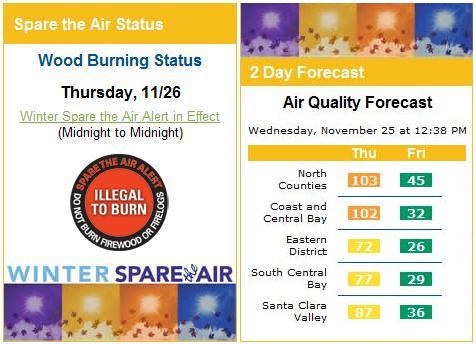
Here’s fair warning:  don’t use your fireplaces or wood stoves today!  Although it may be tempting to create some ambiance for Thanksgiving, we are also celebrating the very first Spare The Air Day for Winter 2009-2010.

The Coast and Central Bay, where Oakland’s located, is hitting 102 today. That level is considered “unhealthy for sensitive groups,” and all active kids or adults with respiratory problems like asthma are advised to limit outdoor exertion.

At least our air quality improves quickly, and we’re in the clear from Friday through Sunday.  According to the Five-Day Forecast, we’re back to good quality again – so there’s no excuse to get out and move around after today’s gluttony.

In the meantime, have a mellow T-Bird Day.

Does Community Policing Work?

Maybe we’ll never know, for sure, whether community policing works.  “The emperor has no clothes,” declared Montclarion Jim Dexter.  “There’s no information about what the PSOs are doing…no accounting as to what they are really doing.”

Jim Dexter was a public commenter appearing at the Measure Y Oversight Committee meeting, last Monday.  He appreciated the good work from local PSOs (problem solving officers), but was responding to the performance report presented that evening.

Latest Measure Y Report

It was interesting to hear Oakland’s consultants report on Measure Y performance, which was gauging whether “community policing adhered to the principles of Measure Y.”  The presenter pointed to police department accomplishments which included assigning officers to all beats, cooperating with neighborhood crime prevention councils, and improving geographic accountability.

The consultant discussed some failures as well.  First, PSO slots experience high turnover and that’s a barrier to success.  Additionally, current information systems limit the ability to analyze problems or manage expenditures.  There didn’t seem to be any shared vision or articulated approach in the department, either.

Even the consultants knew they were operating with incomplete information.  In a better world, the presenter articulated what should be measured:

  • Changes in type of problems reported by residents
  • Number and type of high priority problems integrated in beat plan
  • Number and type of high priority problems successfully addressed
  • Level or implementation of problem solving model/steps
  • Changes in resident perceptions of public safety
  • Changes in resident perceptions of police
  • Changes in crime levels

More Discovery And Questions

The review is underway, but clearly not done.  On Monday, various questions emerged to understand this performance report better, especially about its comprehensiveness and validity:  Who was surveyed?  What were they asked?  How does the PSO tracking software work?  What are the PSOs required to report here?  And so forth.

Marleen Sacks, an Oaklander who filed a suit about Measure Y compliance, stated the report wasn’t critical enough.  “Everybody in this room should share the same goal…oversight of Measure Y.  This report is evidence that not everyone in the room shares that goal.  Numerous aspects of Measure Y have still not been implemented.”

No one questions the underlying realities related to budgeting and staffing of the Oakland Police Department.  It’s a foregone conclusion they don’t have administrators who might collect, slice or dice performance data.  So much for Measure Y compliance, right?