Bay Bridge Dowager Shows Her Age

We’ve been spellbound by the Oakland Bay Bridge construction this weekend, and the bridge is definitely showing her age.  During the full-bridge inspection of the Eastern Span, Caltrans engineers discovered an I-Bar crack, and are running at warp speed to fix this support structure problem.

Caltrans Morning Briefing

Mike Fornier, Caltrans principal construction engineer, explained “the crack we discovered is significant, it’s visual from the ground, and it’s about 100 feet in the air.”  There are eight I-Bars, so the other seven have taken up the load but still…this is a serious problem.

The 73-year-old piece has rusted out and must be fixed right now.  The crack is far away from the current bridge bypass and is thoroughly unrelated to this bypass construction.  Caltrans believes the crack developed during the past few months, but could have been related to original weaknesses in the metal.

This morning, we all learned the bridge would have been closed to fix this problem alone!  Of course, the engineering cognoscenti got to work immediately:  a design plan was developed; materials were ordered; and parts are now getting fabricated.  Engineers are awaiting deliveries, and a 10-man crew is ready to make the repairs.

Yes, Caltrans is committed to completing this as quickly as possible.  But we can’t help but think this sounds like one of those TV design shows with a deadline.  Will this get fixed by Tuesday morning at 5am?  In this case, fixing it matters more than making it pretty in time.

P.S.  The good news is the Oakland Bay Bridge bypass has been successful, and final joints are getting installed there.  “The 3600-ton segment was set down within a half-inch tolerance,” said Caltrans Spokesman Bart Ney, “right on the money.”

September 8th update: The bridge opened around 6:30am this morning, congrats to Caltrans.
October 27th update: The bridge closed again at 8:00pm, when part of the fix fell down (more here).

Why Casual Commuting Works

The Bay Area has a commuting option that doesn’t seem to exist elsewhere:  casual commuting.  We should count our blessings there’s a thriving and alternative means of hopping over the Oakland-Bay Bridge, right at our disposal.

In a nutshell, casual commuting is all about unscheduled but reliable carpooling.  Drivers can easily pick up passengers, and cross the Bay Bridge via the free, high-speed lanes into San Francisco.  There are specific places where passengers wait for free rides, in the East Bay as well as San Francisco.
The Casual Commuter

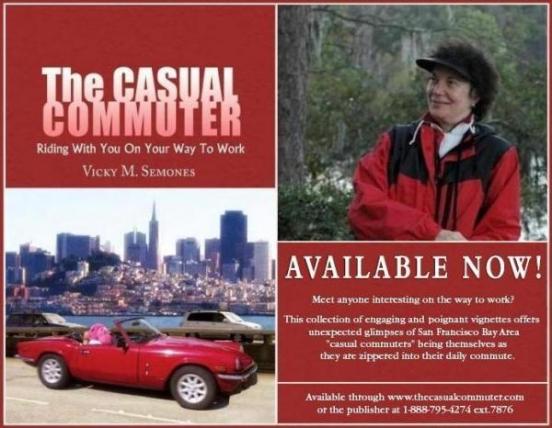
To honor our sui generis commuting option, The Casual Commuter has been written recently by now-retired commuter Vicky M. Semones.  The book is a collection of vignettes that resonate on first read, and seem even better when you return to them a second or third time.  You peer through the windows at drivers, vehicles and commuters of all stripes.

A short while ago, we posed questions to Vicky Semones and wanted to share her motivations and perspectives.  She wrestled with commutes all over the Bay Area, for 25 years.  Her last position, with the Environmental Protection Agency in San Francisco, gave her a front or back seat daily from Oakland.

Q.  Why do you think that the casual carpool works in general?
My first thought is that most of the casual carpool locations are near bus stops.  This provides a dual alternative for daily commute needs:  either the structured bus schedule or the more laissez-faire approach of catching a free ride whenever there’s the right combination of drivers and riders for the casual carpool.

People are resilient and creative when it comes to overcoming obstacles – such as the 1970s East Bay transit strike that lead people to the casual carpool.  People know a good deal when they see one.  They either want or need flexibility in their commute schedules and perhaps a sense of independence.  And really it is a success story in mutual accommodation, whether anyone professes that or not.

Q.  Why do people trust each other in Bay Area?
The Bay Area is a wonderfully rich locale of diverse peoples.  I believe people want to trust one another and believe that they are trustworthy as well.  Our similar patterns of life provide the basis for expectations of personal behavior that allow trust to blossom.

Q.  Where did you partake of casual carpool?
I began riding the casual carpool shortly after moving to Oakland in 1997 until I took an early retirement in 2003.  I was usually challenged trying to catch the morning “V” line down Park Boulevard and couldn’t always relay on a ride to BART.  Then I realized there were three casual carpool locations within easy reach [along Park Blvd and at Lakeshore & Grand] and the ride would be free.  So, one day, I parked my car, took a deep breath, played “follow the leader” and got in line.  And I was never disappointed in the variety of characters or situations.

Q.  Where did the stories all come from?
The stories emerged from my personal experience of the casual carpool.  As a poet I tend to be sensitive to an essence or energy of a person or a place; an unspoken mood.  Sometimes these energies “spark” or are a subtle sensibility which allows me to focus on the people, situation and environment.

Q.  What was single most shocking passenger story?
My most shocking ride was “On the Run.”  I felt uncomfortable on the wild, unpredictable ride especially because the driver was so disconnected from the reality around him; apparently frazzled in his life and profession; unaware of his impact on those around him, including his passengers.

Q.  What was the most disgusting driver story?
It’s a toss-up between “Nail Biter” and “Brush.”  I understand everyone has a neurosis or a tic, but it was the combination of nail biting and head scratching that made me glad I had a light breakfast when I rode with the “Nail Biter.”  And I must have been a newbie rider when I got into the filthy car driven by “Brush” – yuck!

Q.  Why did you decide to write the book?
When I wrote the vignettes, I did not have the intention of writing a book.  It was after I retired that I turned my attention back to them as I did to other creative ideas and with the encouragement from family, I refined the stories, developed a book proposal, believed I had something to say and saw that I did indeed have a manuscript.

Q.  What are your hopes and dreams for the book?
My hope is that people will resonate with the stories; see that we are part of a larger community; that we have shared experiences.  While marketing “The Casual Commuter” I see people smile in recognition with the title, thinking of their own casual carpool experiences.  As a poet and a former teacher, I find the moment of connection with another person to be so fulfilling:  an understanding, a shared perspective, a common bond.

I feel that the book is already a success – it’s published! And it would be wonderful for it to be a regional hit which reflects the uniqueness of the Bay Area. And especially during these problematic and unpredictable times, “The Casual Commuter” is a humorous, yet compassionate look at ourselves…you can’t beat that!

We encourage you to pick up this compact collection, whether you partake of casual commuting or not. Throw out your preconceived notions about people, as the shared drive time is all about following unwritten rules and seeing how people behave through this honor-system.  The Casual Commuter offers an amusing and literate perspective of Oakland’s myriad characters, who just happen to commute.

Thinking about it, we’re surprised that no one seemed to write about this phenomenon during the past three decades – but are glad that poet Vicky Semones decided it was worth her time and energy!

More info:  You may order The Casual Commuter online, at Amazon or at Barnes & Noble.  Learn more about casual carpools through this overview.  Check out the casual carpool spots on this Google map, and find out more at RideNow.

Goodbye To The Old Eastern Span

As planned and planned, the San Francisco-Oakland Bay Bridge is closed for the next four days. The bridge that we took for our entire lives will be no more, as the detoured route will be in place starting Tuesday morning.

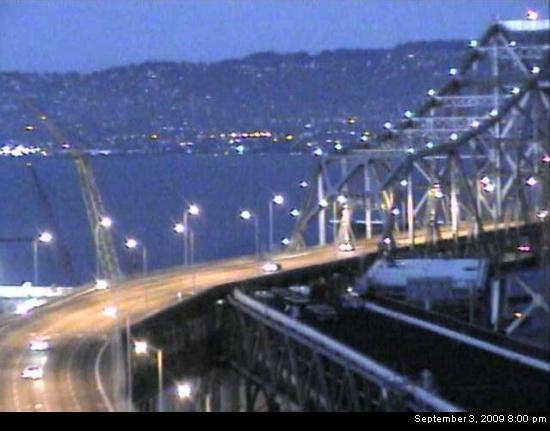
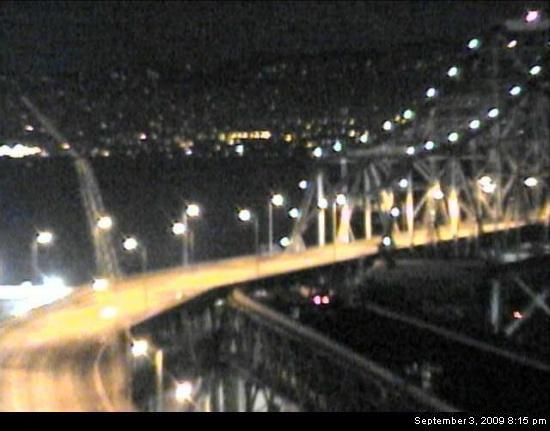
We captured a little history in the making, with the very last cars making their way on the old Eastern Span over to Yerba Buena Island.  Here are screenshots taken from 8pm through 9pm tonight.  You can see the last passenger cars, no traffic at all, construction vehicles arriving, and apparatus lighting up and settling in…below.

800 pm

815 pm

830 pm

900 pm

The weekend activities will be fascinating to behold, because of the sheer project scale:  the Oakland Bay Bridge undergoes its very own bypass surgery.  While the new section of bridge is a “temporary fix” for the next few years, this replacement takes a highly-orchestrated feat of engineering ingenuity.

Construction’s supposed to wrap up by the wee hours of Tuesday, and we are holding our collective breaths that the bypass succeeds.  Maybe the bridge karma is good right now, and this project will even finish up early like the smaller project two years ago.

In the meantime?  See what’s happening live at the Caltrans construction video, which works really well.  Also some of the local TV stations have nice video streams:  CBS5 video camKTVU2 video camABC7 video camKRON4 video cams.

For any Oakland-to-San Francisco commuters, please feel free to share your war stories tomorrow.  We feel for you.  The rest of us will avoid that other city for now, thank you.

Welcome Back To School, Reality Checks

The new school year should be a joyful time, filled with renewal and hopefulness.  There’s something about seeing teachers, parents and students buzzing around again…which reminds us of other realities.

The Teachers

We are so lucky to have great teachers!  Here’s a quick shot of Jennifer Formoso, a first-grade teacher at Thornhill School, taking a breather during her final classroom preparations last Friday.

Reality Check #1 – Since we live in Oakland, the teachers aren’t exactly overpaid.  Yet they take responsibility for making sure students are supplied properly, and spend their own money to do so.  Pencil boxes anyone?

Thornhill School Teacher

The Schools

Our elementary schools do offer solid educational experiences, as evidenced in the annual academic test scores for hills kids.  Everyone truly cares, and that combination of parents and teachers works well.

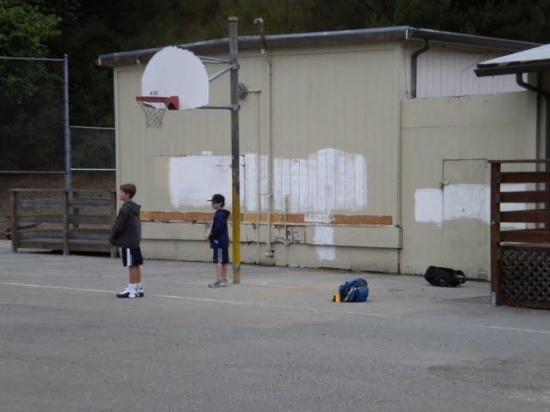
Reality Check #2 – The school facilities and grounds are part of sound education, and have seen better days.  Just look at the Montclair School, in this picture snapped Monday.  Does this look like a first-rate environment?

Montclair School Yard

The Access

In the calculus of Montclair living, residents want their progeny to attend good, convenient schools.  They note the nearest elementary school and likely figure it’s within walking or bike-riding distance, so all is well.

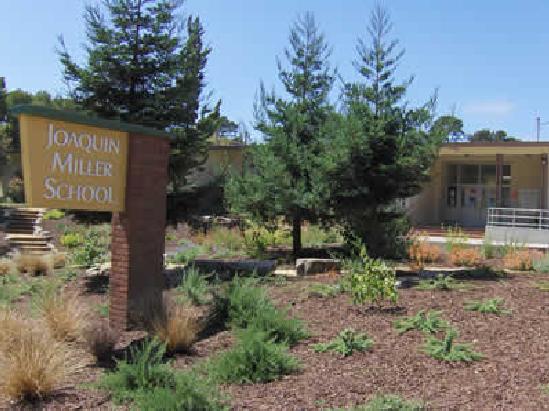
Reality Check #3 – Yesterday the traffic was at a standstill around Joaquin Miller School (and Montera School), raising the blood pressure of parents and other drivers.  Why aren’t there safe, walkable paths to school?

Joaquin Miller School Access

Welcome back to the Oakland Hills schools, for the 2009-2010 year.  We’re proud of the education for our kids and the cooperation among principals, teachers and parents.  We accept that fundraising is important so programs like the arts – “free” in our era – are still offered to hills kids.  Though it sure would be nice if Oakland budgeted and paid for the basics.

What Does MOBN Mean?

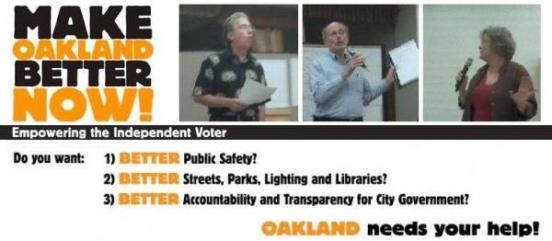
MOBN is a brand-new Oakland acronym making the rounds, which stands for Make Oakland Better Now.  It’s no mystery about what MOBN seeks to do, though:   identify the key issues Oakland mayoral candidates should address next year.

Make Oakland Better Now

Oaklander Bruce Nye (in the left photo, above) came up with the idea, and organized a kick-off meeting last week.  He gathered some of his friends to wrangle opinionated meeting-goers.  There was surprisingly civil discourse, as the wranglers had no axes to grind and focused on gathering as many issues as possible.

At least 100+ people came to this evening meeting, held at St. Theresa’s Church in the hills.  There were bloggers, a couple city workers, a city council member, and concerned citizens who had read about the meeting online.  The first issue emerged instantly, namely to hold future gatherings a little closer to public transportation.

After we were told the rules, the crowd split into three groups covering public safety, public works and infrastructure, and accountability/budgeting.  In under two hours, the attendees had created a tsunami of important issues – and it was a very good beginning!

What’s kind of challenging?  Getting down to pointed issues that really could or should be addressed, or else we’ll be trying to solve world hunger.  On the other hand, if those great Bakesale Betty gingersnaps were distributed beyond this first meeting…hhmm.