Why Casual Commuting Works

The Bay Area has a commuting option that doesn’t seem to exist elsewhere:  casual commuting.  We should count our blessings there’s a thriving and alternative means of hopping over the Oakland-Bay Bridge, right at our disposal.

In a nutshell, casual commuting is all about unscheduled but reliable carpooling.  Drivers can easily pick up passengers, and cross the Bay Bridge via the free, high-speed lanes into San Francisco.  There are specific places where passengers wait for free rides, in the East Bay as well as San Francisco.
The Casual Commuter

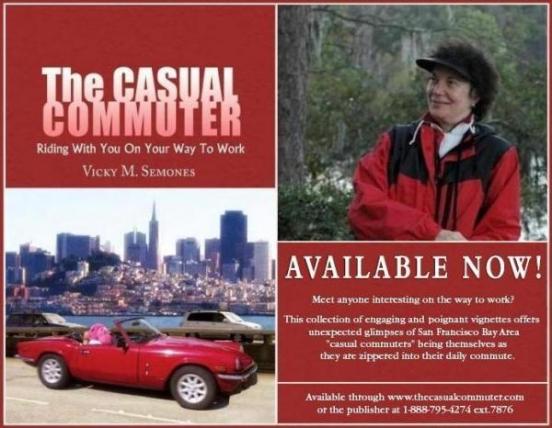
To honor our sui generis commuting option, The Casual Commuter has been written recently by now-retired commuter Vicky M. Semones.  The book is a collection of vignettes that resonate on first read, and seem even better when you return to them a second or third time.  You peer through the windows at drivers, vehicles and commuters of all stripes.

A short while ago, we posed questions to Vicky Semones and wanted to share her motivations and perspectives.  She wrestled with commutes all over the Bay Area, for 25 years.  Her last position, with the Environmental Protection Agency in San Francisco, gave her a front or back seat daily from Oakland.

Q.  Why do you think that the casual carpool works in general?
My first thought is that most of the casual carpool locations are near bus stops.  This provides a dual alternative for daily commute needs:  either the structured bus schedule or the more laissez-faire approach of catching a free ride whenever there’s the right combination of drivers and riders for the casual carpool.

People are resilient and creative when it comes to overcoming obstacles – such as the 1970s East Bay transit strike that lead people to the casual carpool.  People know a good deal when they see one.  They either want or need flexibility in their commute schedules and perhaps a sense of independence.  And really it is a success story in mutual accommodation, whether anyone professes that or not.

Q.  Why do people trust each other in Bay Area?
The Bay Area is a wonderfully rich locale of diverse peoples.  I believe people want to trust one another and believe that they are trustworthy as well.  Our similar patterns of life provide the basis for expectations of personal behavior that allow trust to blossom.

Q.  Where did you partake of casual carpool?
I began riding the casual carpool shortly after moving to Oakland in 1997 until I took an early retirement in 2003.  I was usually challenged trying to catch the morning “V” line down Park Boulevard and couldn’t always relay on a ride to BART.  Then I realized there were three casual carpool locations within easy reach [along Park Blvd and at Lakeshore & Grand] and the ride would be free.  So, one day, I parked my car, took a deep breath, played “follow the leader” and got in line.  And I was never disappointed in the variety of characters or situations.

Q.  Where did the stories all come from?
The stories emerged from my personal experience of the casual carpool.  As a poet I tend to be sensitive to an essence or energy of a person or a place; an unspoken mood.  Sometimes these energies “spark” or are a subtle sensibility which allows me to focus on the people, situation and environment.

Q.  What was single most shocking passenger story?
My most shocking ride was “On the Run.”  I felt uncomfortable on the wild, unpredictable ride especially because the driver was so disconnected from the reality around him; apparently frazzled in his life and profession; unaware of his impact on those around him, including his passengers.

Q.  What was the most disgusting driver story?
It’s a toss-up between “Nail Biter” and “Brush.”  I understand everyone has a neurosis or a tic, but it was the combination of nail biting and head scratching that made me glad I had a light breakfast when I rode with the “Nail Biter.”  And I must have been a newbie rider when I got into the filthy car driven by “Brush” – yuck!

Q.  Why did you decide to write the book?
When I wrote the vignettes, I did not have the intention of writing a book.  It was after I retired that I turned my attention back to them as I did to other creative ideas and with the encouragement from family, I refined the stories, developed a book proposal, believed I had something to say and saw that I did indeed have a manuscript.

Q.  What are your hopes and dreams for the book?
My hope is that people will resonate with the stories; see that we are part of a larger community; that we have shared experiences.  While marketing “The Casual Commuter” I see people smile in recognition with the title, thinking of their own casual carpool experiences.  As a poet and a former teacher, I find the moment of connection with another person to be so fulfilling:  an understanding, a shared perspective, a common bond.

I feel that the book is already a success – it’s published! And it would be wonderful for it to be a regional hit which reflects the uniqueness of the Bay Area. And especially during these problematic and unpredictable times, “The Casual Commuter” is a humorous, yet compassionate look at ourselves…you can’t beat that!

We encourage you to pick up this compact collection, whether you partake of casual commuting or not. Throw out your preconceived notions about people, as the shared drive time is all about following unwritten rules and seeing how people behave through this honor-system.  The Casual Commuter offers an amusing and literate perspective of Oakland’s myriad characters, who just happen to commute.

Thinking about it, we’re surprised that no one seemed to write about this phenomenon during the past three decades – but are glad that poet Vicky Semones decided it was worth her time and energy!

More info:  You may order The Casual Commuter online, at Amazon or at Barnes & Noble.  Learn more about casual carpools through this overview.  Check out the casual carpool spots on this Google map, and find out more at RideNow.

Welcome Back To School, Reality Checks

The new school year should be a joyful time, filled with renewal and hopefulness.  There’s something about seeing teachers, parents and students buzzing around again…which reminds us of other realities.

The Teachers

We are so lucky to have great teachers!  Here’s a quick shot of Jennifer Formoso, a first-grade teacher at Thornhill School, taking a breather during her final classroom preparations last Friday.

Reality Check #1 – Since we live in Oakland, the teachers aren’t exactly overpaid.  Yet they take responsibility for making sure students are supplied properly, and spend their own money to do so.  Pencil boxes anyone?

Thornhill School Teacher

The Schools

Our elementary schools do offer solid educational experiences, as evidenced in the annual academic test scores for hills kids.  Everyone truly cares, and that combination of parents and teachers works well.

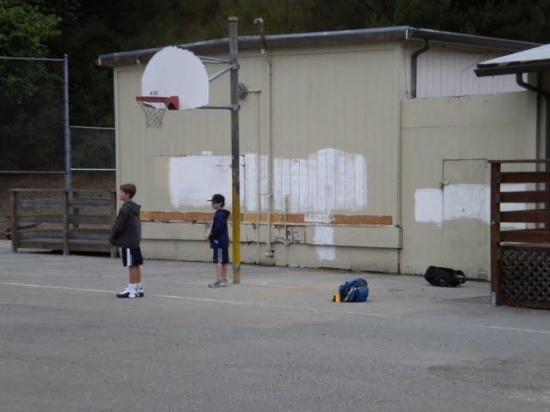
Reality Check #2 – The school facilities and grounds are part of sound education, and have seen better days.  Just look at the Montclair School, in this picture snapped Monday.  Does this look like a first-rate environment?

Montclair School Yard

The Access

In the calculus of Montclair living, residents want their progeny to attend good, convenient schools.  They note the nearest elementary school and likely figure it’s within walking or bike-riding distance, so all is well.

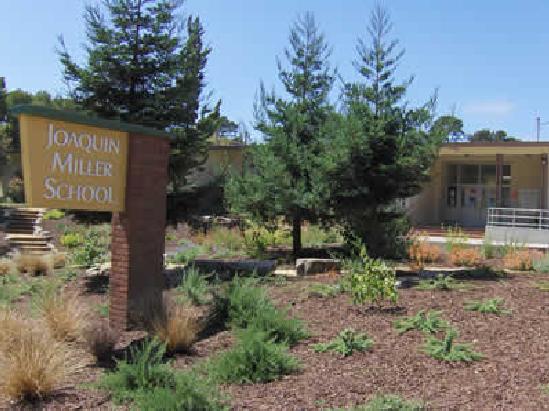
Reality Check #3 – Yesterday the traffic was at a standstill around Joaquin Miller School (and Montera School), raising the blood pressure of parents and other drivers.  Why aren’t there safe, walkable paths to school?

Joaquin Miller School Access

Welcome back to the Oakland Hills schools, for the 2009-2010 year.  We’re proud of the education for our kids and the cooperation among principals, teachers and parents.  We accept that fundraising is important so programs like the arts – “free” in our era – are still offered to hills kids.  Though it sure would be nice if Oakland budgeted and paid for the basics.

Taking A Montclair Appreciation Tour

We decided to take an historical tour featuring Montclair today, but wondered how anyone could schedule 2.5 hours for such an event.  After all, we’re a far cry from ancient Rome.

After taking this walk and talk, we understood and have become disciples of the Oakland Heritage Alliance.  There’s plenty to learn about our area, the first Euro settlers, village development, landmarks and even buildings that usually go unnoticed.

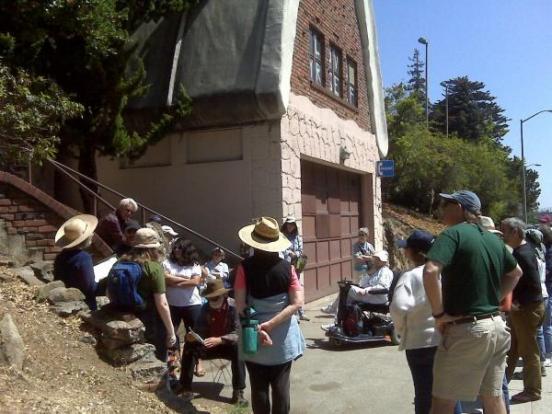
Montclair Appreciation Tour - Firehouse Stop

Docent Kathleen diGiovanni is an Oakland librarian who clearly knows her craft.  She researched everything well, and told us what was documented versus hearsay.  She explained what “was there” or “happened there” all over the village.  And she brought along old photos so we could compare yesteryear with today.

Here’s some of what we learned this afternoon:

  • Texas Ranger John Hayes was the first Euro settler who owned all the land from north of Berkeley through part of Hayward.  He was legit, having purchased (rather than stolen) his land from the Peraltas.  He didn’t actually live in our hills, though.
  • The first Montclarion settlers were perched near the Thornhill-Moraga exit, on the Thornhill side.  Back then, they lived on Hayes Road.  The name later changed to Thorn Road, honoring logger Hiram Thorn.  When realtors hit town, they decided on Thornhill.  Today there are some stones along the northern reaches that might have edged the first settlement, but no one’s exactly sure.
  • Folks from a hundred years ago really didn’t understand the value of trees. It seems that everyone was obsessed with blue-gum eucalyptus trees.  After all the original growth redwoods were logged out, these trees were planted because they were supposed to remove malaria risks in the swamps and provide good hardwoods for building – but they were not particularly useful after all.
  • Original real estate developers wanted Montclair Village to look like Carmel, at least from an architectural perspective.  There are a few vestiges left in the village, such as the Spanish style bus depot that now houses Le Bonbon.  There also used to be a really nice building housing the Montclarion, but it was razed to build a gas station.  So much for preservation ideals back in 1961!
  • Fortunately, some of the original buildings stayed intact. The 1920s and 1930s storybook charmers remain in Fernwood, as well as the Montclair Library and old Fire Station.  Other later era structures have gotten covered up, such as a wood-clad, hip 1950s building where Noah’s Bagels sits.  As we walked south on Mountain, we looked at original buildings near Luckys – and realized they might seem nicer as time marches on.
  • Vestiges of the trains running through Montclair are prominent, when you poke around Montclair Park and Mountain Avenue.  You can imagine where the massive berm was located, as verified by Montclair School alums who used walking tunnels through it.  After the Sacramento Northern trains ceased operations in the 1950s, the earth-berm was removed entirely.

Anyway, kudos to the Oakland Heritage Alliance.  While there were a few dozen people appreciating Montclair on the tour, we’re pretty sure that most Montclarions would have gotten a big kick out of the stories told about our little burg today.

Oakland’s Museum Temporarily Fades From View

Like most Oaklanders, we’re saddened by the upcoming closure of the Oakland Museum of California.  Where will we go for our traditional wildflower and mushroom shows?  Where will we take visitors, who always get a kick out of the old timey, California galleries?  And where will we get a reliable, satisfying hit of art and culture?

Assuming the Oakland Museum holds on to its unique identity, we’re all for overdue improvements to the physical plant.  These are the first renovations since Neil Armstrong and Buzz Aldrin set foot on the Moon (and the Hornet, but that’s another Oakland story).  In fact, the museum and gallery design plans look terrific and you can view them here.

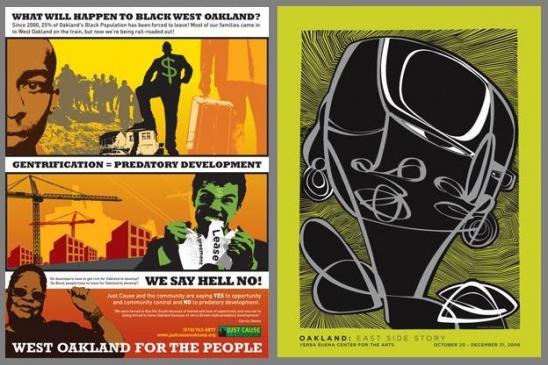
Favianna Posters

As Oakland’s museum temporarily fades from view, the natives are curious about what happens after August 23rd.  We already know the history and art galleries are supposed to re-open in May 2010, while the natural sciences gallery re-emerges sometime in 2012.  Meanwhile, the museum will continue living, breathing and transforming itself.

Museum Collection Moves Out

Well, there’s a lot of time involved in dismantling rooms, exhibits and an entire museum.  “It depends on the size and complexity of the exhibition.  A painting show will dissemble more easily than large sculpture or fragile artifacts,” explained Elizabeth Whipple, Communications Manager for the Oakland Museum.  “Think of the water pump truck used in the 1906 fire and quake:  valuable, fragile, hard to move and store, essential to the History Gallery.”

The difficult move means that the treasure trove won’t move (or hasn’t moved) far away.  Back in 2007, the museum opened their state-of-the-art California Collections and Research Center.  So the trove is getting sorted, conserved and stored in a safe and undisclosed location within city limits.

It’s mind-boggling to deal with more than 1.2 million objects in the collection – including over 70,100 works by California artists, one million objects and photographs about state history and people, and 112,090 objects documenting the local ecology.

Museum Brain Trust Keeps Working

Whipple said the staff remains hard at work, as usual.  “Curators do much of their work at their desks (on the phone and internet), in meetings, and visits to other museums and artists’ studios.  That won’t change.  They don’t work in the galleries, except to give occasional tours to peers and the public.”

More importantly, no one will lose their jobs at the museum.  Due to the one-time nature of the renovations, some  staff will be assigned to other roles – and there’s plenty to do before next spring’s launch and reopening.

Even the museum docents will continue their training courses.  The history docents have received initial training at a live exhibit, and will attend storytelling and improv workshops.  Their art counterparts are learning how to look at art carefully, and will train in the unfinished art gallery this winter.

Museum Offers Cultural Snacks

Oaklanders won’t be left completely high and dry during the closure period, because the museum will offer cultural snacks to all takers.  Keep on the lookout for a range of talks, presentations and displays in the months ahead.  Here are few things already planned:

  • Public Art – The construction zone will become an art zone instead.  Oakland arts activist Favianna Rodriguez has been asked by the museum to install public art on the plywood wall fronting Oak Street.  She does beautiful and provocative work, including the posters shown above, and we can’t wait to see what she’ll do with all that space.
  • Native Crafts – Ohlone historian Linda Yamane has been commissioned to create an authentic basket, which Whipple declared as “the first Ohlone basket created in California in hundreds of years.”  Yamane will grow, dry, flatten, design and weave it herself – and visitors will be able to see her working on the heirloom.
  • Online Dia – A “Virtual Day of the Dead” is in the planning stages, where Oaklanders would submit ofrenda images for this composite, online show.  Oakland celebrates Dia de los Muertos on a grand scale every year, so why not pay homage to it?

Museum Still Visits The Public

Educational programs will be available without interruption as well, including presentations at classrooms and other city venues.  On the agenda are the Gold Rush, a nature sciences class about birds, and the California Indian Lifeways program.  If you would like more information, then please reach Joan Collignon, at (510) 238-3515.

Last but not least, the Museum Store will be available online.  While this store offers only a few books and maps today, it’s supposed to get stocked more fully.  We depend on their selection for many “what should I buy” gifts, especially around the holidays.

Remember, the countdown begins now.  You have only a few weeks, until August 23rd, to drop by the museum before it shutters for eight full months.  We suggest checking out the current exhibits – about Africans in Mexico,  Berkeley-based artist Squeak Carnwath, and the Giant Sequoias – as a fond farewell to this unrenovated friend.

Practical Considerations, We Want Longs

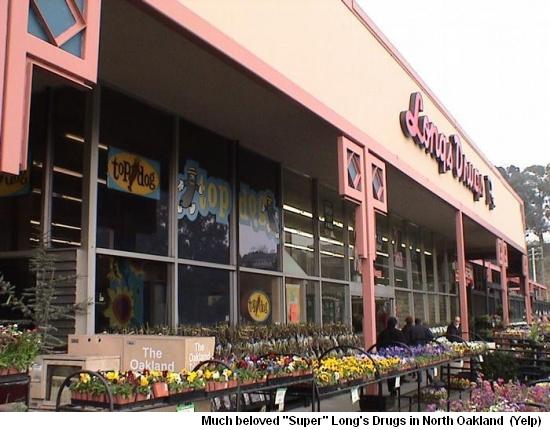
There’s buzz lately about Safeway and their redevelopment plans for Rockridge Shopping Center.  As a first step, they intend to occupy the Big Long’s Drugs site and have already put the wheels in motion for mall modifications.  Many Oaklanders seem to be chatting about urban renewal possibilities there, so we wondered about your reactions in particular.

Long's Drugs, North Oakland

Well, Montclarions seem to be focused on practical considerations and their everyday, last-minute needs.  A nicer shopping venue would be great and all, but we have hella-love for this Long’s location and don’t want to see the place die:

The Long’s at Pleasant Valley is the only place where Oaklanders can go for a one-stop variety of things – drugstore, hardware, garden center, shoe repair, fabric, furniture, and appliances.  I’d hate to see it go.  Our city needs a general store, no matter if it’s in an auto-centric mall.

Oh no!  I was just at this Long’s tonight.  Diapers, vitamins, pie tins, swimming gear, a birthday card, and some groceries.  I love it for being so vast and exhaustive.  Everything’s there.  Even Top Dog.

Love that Long’s – 24 hours a day, with everything you could ever need.  Nothing else in the area comes close.

Apparently Montclarions are not alone in their Long’s adoration.  On Yelp, some 172 Oaklanders have even awarded 4.5 of 5 stars to this location.  You can read about shoppers who arrive at odd hours for things they need or didn’t know they needed.  One reviewer, on hearing about the closure, exclaimed: “Where else are we Oaklanders supposed to go during the Zombie Apocalypse?”

Regardless of the pro-Long’s contingent, reviews of mall changes are underway.   Oakland’s Planning Commission is soliciting comments on the scope of the environmental impact report tonight.  Many cool ideas have been surfaced by Oaklanders about transforming the entire mall footprint and creating a friendlier urban hangout.

Yet one thing seems clear:  your cries to save Long’s Drugs will fall on deaf ears.  You should start preparing for the loss of this geriatric and well-loved Long’s, due to expire sometime next year.  Getting a CVS or other drug store replacement simply isn’t the same thing.

More info:  A Better OaklandSan Francisco ChronicleLiving in the OTransbay BlogOur OaklandSafeway Redevelopment ProjectJuly 15th Meeting News