Hiding In 94611 Real Estate Forest

How is the real estate market in our beloved 94611 zip code?  If you look at median prices and foreclosures, then the market appears to be leveling out.  When you look at sales volumes, that’s where the trouble spot seems to emerge.  Let’s go visit the forest and trees.

Median Sale Prices Moderated

Cyberhomes most recently reported $709,980 median price (from August) versus $718,918 six months ago, only a 1.2 percent seasonal drop.  These medians each reflect 14-15 percent declines since last year, so they have steadied now.

Another source, City Data, shows quarterly price trends since 2004.  When you check the fat red line below, it’s obvious the 94611 zip prices crashed back in 2007 and declined further last year.  But things are relatively flat these days.

City Data, 94611 - Q2, 2009

Far Fewer Homes Sold

Now there’s a real story behind the precipitous drop in sales transactions, which began in earnest this year.  Take a look at City Data’s blue-colored bars, in the chart above, and you see the plummet during the first half of 2009.

Over 50 homes sold in the first quarter, or about a one-third drop from the same quarter 2008.  Things seemed to get even worse second quarter, with fewer than 50 homes sold – a two-thirds drop since last year.  Yup, potential sellers aren’t selling.

Foreclosures, 94611 - 2008-2009

Foreclosure Levels Declined

RealtyTrac reports the grimmer foreclosure facts related to defaults, trustee sales and bank-owned properties.  Over the past six months, overall 94611 foreclosures have gone down – and this contrasts with overall Oakland and Alameda County trends.

We wonder if there’s a flash point for homeowners, though.  Many people have been been hit hard by this recession, though it’s impossible to say whether that translates into a trickle or stream of “must sell” homes ahead.

So there is a real estate forest, and it’s easy to hide there! You can walk by and conclude that market is settled, but a little quiet and tamped down.  When you stop and really stare at the trees and wildlife, you see plenty of dynamic influences too.  We’ll have to wait patiently and watch the post-recession changes and equilibrium in there.

Top Ten Reasons Montclair Works

Don’t worry, we aren’t wearing 100% rose-colored glasses.

After a nice weekend when we kept running into friendly faces, I started thinking about why Montclair works for us.  It’s a mix of the geography and the people, for starters.  Yet we are making a conscious decision to live in Oakland, even though there are plenty of great places in the Bay Area.

Fall Flowers In Montclair

What gives?  As the season abruptly changes, it felt like time to describe why Montclair works – but with caveats included as well.  So here are the Top Ten Reasons Montclair Works:

10.  Flowers bloom all year – Right now there are lovely purple flowers, and last month we saw the naked ladies (really called that, too).  Downside? Mother Nature also delivers mudslides, droughts and fire seasons.

9.  That weather, that weather – In the hills, the weather cools at night and warms in the days.  It’s nice up here.  Downside? Some days, we crave a little morning sunshine and curse that marine layer.

8.  Historical buildings aren’t old – We’re already preserving and honoring buildings less than a century old, like the Fernwood Drive storybook cottages.  Downside? We don’t have anything on downtown Oakland, where it all really started.

7.  Older guys standing sentinel – If you are living on the right block, then you know the older guy who’s been here for at least two score.  Downside? He may know everything, maybe too much.

6.  Shopkeepers who know you – Around here, merchants will remember you, know your preferences and likely trust you.  Downside? Forget turning into a complete recluse, as it takes effort to do.

5.  Schools of people – If you had or have kids in grade school, then you know about the intense parent, teacher and principal engagement.  Downside? Putting money into buildings, grounds or maintenance isn’t a priority.

4.  Our little, cute critters – We do like spotting deer, turkeys, airborne birds and occasional coyotes.  Downside? We’re less fond of the raccoons, skunks, rats, spiders or ants invading our turf.

3.  Oakland’s polyglot – There’s such a mix of different people, from so many different walks of life.  Downside? The economic and geographic divides are very stark.

2.  City or no-city – Montclair Village seems suburban or exurban, with the city this-close.  Downside? Nothing like the hills as a magnet for stealing cars or robbing homes!

1.  There’s a somewhere, there – Montclair boundaries are a bit amorphous, and we like it that way.  Downside? Oakland divides us into pieces, for police beats and council representation.

With these reasons in hand, you should feel pretty good about living here but hardly complacent.  As Hillary Clinton must have declared, “it takes a Village or District to make a difference, to speak up and pitch in.”

Fernwood, Perfect For Oakland Founder Hays

Come take a peek at the Fernwood area on Sunday, when Montclarions will open their historical homes to the public.  The legacy of Fernwood makes this a “must see” place in Oakland – as a unique little enclave.

Back in 1852, Colonel John Coffee Hays decided the Temescal Creek was a perfect place for a homestead which, for obvious reasons, he called Fernwood.  If the place was good enough for Oakland’s founding father and first mayor, then there must be something special about it.

Fernwood - Storybook House

Fernwood Gets Settled

Colonel Hays built a large estate at Fernwood, which Wood’s History of Alameda County called “one of the most beautiful of the State and located at the base of the verdure-clad hills of the Coast Range, in a quiet nook [with] lordly oaks and a handsome building and exquisite art.  Indescribable views in every direction.”

After Hays died, two other landed gentry occupied the area.  The Dingees lived there first, until their opulent home burned down.  Later the Percy family lived a little more modestly there.

The fun began after Marion “Borax” Smith and Frank Havens decided to develop this tract.  These were the guys running “Realty Syndicate,” which also developed the Key System and the City of Piedmont.

This time, they wanted to create a place where homes were lovely yet more whimsical.  They marketed the heck out of this new tract as well.  George Duncan, who’s been lucky enough to live in Fernwood for some 45 years, shared more about the development over the years:

The beginning: The 100 (or so) lots development of Fernwood was in 1924, when Havens started selling off the Dingee Estate after an ad campaign that included naming a ferry boat “The Fernwood,” and conducting motorized sales tours from the ferry for potential buyers from San Francisco.

Hood location: The area of the ‘hood is basically one long block surrounded on the east by Mountain Blvd, between Thornhill on the south and Florence Terrace on the north and Fernwood Dr, on the west.  The area lies about equidistant between Lake Temescal to the north and Montclair Village to the south.

Highway destruction: When Landvale Ave. became State Highway 13, following WWII,  it wiped out all the houses on the west side of Fernwood Dr. that backed on the freeway as well as a neighborhood swim club and three or four tennis courts located on Florence Terrace.

Railroad phase-out: The neighborhood organization, “The Fernwood Club,” came into being to hire attorneys to help protect it when The Sacramento Northern RR stopped running and the intersection at Thornhill and Moraga was remodeled to accommodate a freeway exit and an underpass from the highway.

Spared in 1991: In The Oakland Hills Fire of 1991, we were spared almost certain damage when the fire was controlled a block or two to the north at Broadway Terrace as it climbs up the ridge of hills to Skyline Blvd.

Fernwood - Spanish Hacienda

Fernwood’s Still There Today

The Fernwood neighborhood honors its roots, with vestiges of the original Dingee and Percy estates scattered around the properties.  According to the Oakland Heritage Alliance, Dingee’s legacy includes remains from waterfalls, terraces, fountains, orchards, and vineyards in local yards and gardens.  Percy’s legacy includes various creek-side landscaping, plantings and trees – with some species from the Panama Pacific International Exhibition in 1915.

While most homes were built before WWII, they range from the 1920s through 1960s on the street.  There’s a range of styles instead of cookie-cutter development, yet Fernwood still seems cohesive and natural in its landscape.  While the area’s best known for storybook styles, you can also spot Tudors, Spanish, Mission-Revival, Mission, Regency-inspired and Japanese modern homes there.

The houses emerged from different sources.  In the 1920s, the Spanish homes were designed by Oaklander Roger Blaine who worked with Timothy Pflueger, the architect who created the Paramount Theater.  Another home was designed by a young John Carl Warnecke, who went on to design JFK’s gravesite at Arlington Cemetery.  And several homes were even moved here from the Treasure Island World’s Fair in 1939.

Since fire danger has always been part of our history, some of the homes are fire-proofed fortresses.  After one of the largest fires, the Berkeley Fire of 1924, one notable specimen was constructed with double-brick walls and a slate roof.  The early Fernwood homes look like they were built to last, and have done so.

Fernwood - Old Tudor

Oakland Heritage Alliance’s Tour

Please visit the Storybook Houses of Fernwood this Sunday afternoon.  The Oakland Heritage Alliance (OHA) has organized a self-guided tour through the neighborhood, featuring nine Period Revival homes from the 1920s.  The hours are from 1:00 to 5:30 pm, and you may visit all the homes by walking along Mountain Blvd and Fernwood Drive.

Just show up at 1600 Mountain Blvd, in the Montclair District.  The tour costs $35/person for the tour, or $25 if you belong to the Alliance.  It’s worth every dime, as a major benefit for this group which “advocates the protection, preservation, and revitalization of Oakland’s architectural, historic, cultural and natural resources.”

With a part-time administrator and nine-person volunteer board, the OHA organizes nearly two-dozen walking tours and a dozen lectures annually.  Doug Dove, who’s an OHA board member and Fernwood House Tour chairman, said that tour attendance was very high all summer long.  He expects at least 500 people at Fernwood, including the 60 docents and/or homeowners!

The Fernwood neighbors will be a congenial and welcoming bunch.  They still operate the Fernwood Club, which taps ino the proceeds of invested money from their old freeway fights.  While the Club meets for picnics or dinners, they have also made donations over the years.  Most notably they contributed the brick fireplace for Montclair Library, another storybook structure.

Thus it’s not surprising that nine Montclarions are sharing their Fernwood properties, and supporting the Oakland Historical Alliance this year.  If you have been on any of the historical walking tours before, then you already know the OHA prides themselves on finding experts and having them share their Oakland knowledge.  Fernwood’s open houses are the final tour event for the season – in a cool place to live that we call home.

We Get The Money Views In Oakland

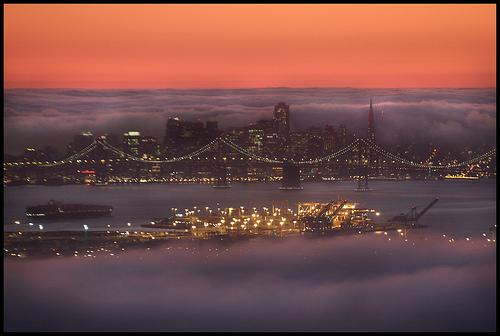
When living in the Oakland Hills, you get the “money views” of the Bay Area.  You may see local trees and hills, which seem like Europe.  You may glimpse the open waters of San Francisco Bay.  You may look at the Marin and Mt. Tam horizon.

However our favorite, endlessly changing view is due West.  Many of us can walk onto our decks and gaze from Oakland across to San Francisco.  It’s all about the changing light and fog, and is a local form of entertainment that beats what’s on air or online.

Typical Montclair View (Bennett Hall)

One of our Montclarion neighbors, Bennett Hall, recently stepped onto his deck and captured this extraordinary evening view.  When he shared the image today, I was simply amazed and had to pass it along – words don’t do justice to this surreal artwork.

Did we mention that we love Montclair?

Welcome To Germany, Oakland

Germany, Oakland?  At least last weekend, German transplants and their heirs showed up at Dunsmuir to honor their roots.  There was a full-on celebration with dancing, flag waving, and local clubs in attendance.  The brats, sauerkraut and beers were plentiful too.

The 79th Annual German Fest was large enough that a German diplomat made a quick and unofficial appearance.  He marveled at the beers ‘n brats love from Americans and wanted to set the record straight.  Apparently Octoberfests are not, in fact, something that most Germans celebrate at all.  The Bavarian Germans are into them, along with Americans.

Flag Parade, Dunsmuir

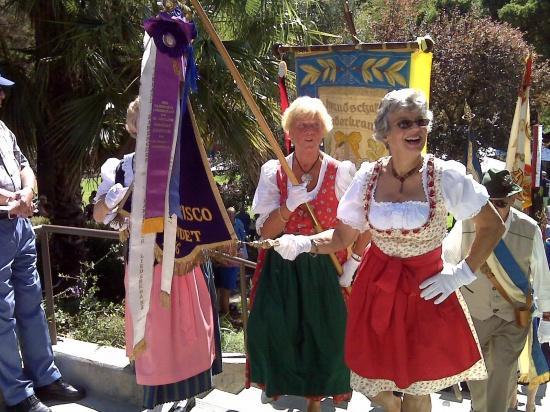
The main ceremony was something called a Fahneneinmarsch, or Flag Parade, where folks marched up the stairs and were acknowledged by all – like these ladies in dirndle-inspired garb.  We don’t think anyone in Germany wears this stuff anymore, right?

Dancers, Dunsmuir

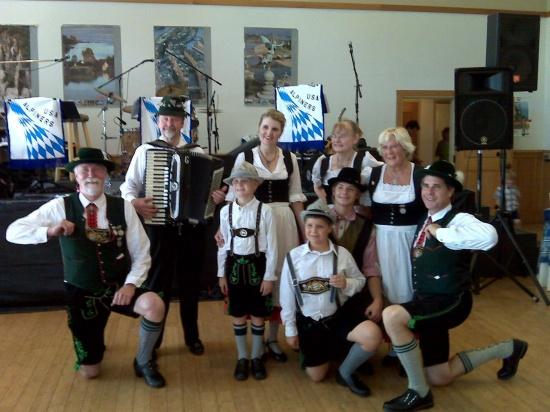
The dance troupe exceeded our expectations (!) and performed all kinds of traditional numbers.  My favorite was the dance featuring one man and two women vying for his attention, with one winning the prize.  It was entertaining to watch these evergreen performers and their kids.

Which Flag, Dunsmuir

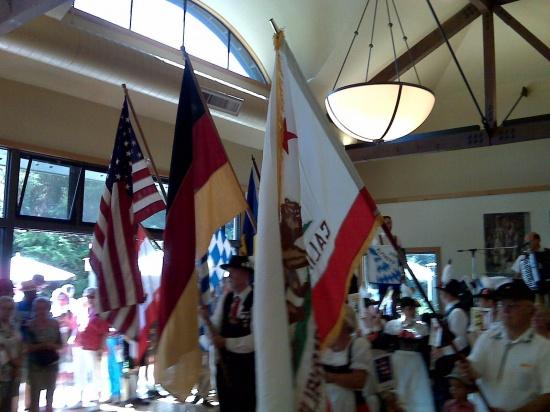
Just to prevent cognitive dissonance, the flag bearers put California, the USA and Germany on equal footing.  The Alpiner band played the US and German national anthems too.  After all, the United German-American Societies of the East Bay (UGAS) organized the festival.

Where is Germany, Oakland? Around Oakland, there are vestiges of the settlers.  The German Tourist Club is a long-standing group which seeks to “foster, perpetuate and preserve the European Alpine social activities, cultural heritage and customs.”  The Club also holds a Biergartenfest every year in the “Oakland Alps,” at their Butters Drive clubhouse.

You also can’t miss the Altenheim, that grand old building on MacArthur Blvd.  The building has been well-renovated and recently celebrated 100 years on the hill.  There’s low-cost senior housing there now, and plans for more units.

The Excelsior German Center, which runs the Altenheim, has a much larger mission to encourage cultural and educational connections with Germany.  They run German language classes and have a library there.  According to Excelsior’s president, Michael Willis, there are some interesting plans afoot – so it’s not all beers ‘n brats really.