Oakland Park Rangers Nearly Extinct

It’s true that the Oakland Park Rangers are on the endangered species list.  There are three rangers now, who can’t possibly roam around the 120+ parks and rec centers throughout the city.

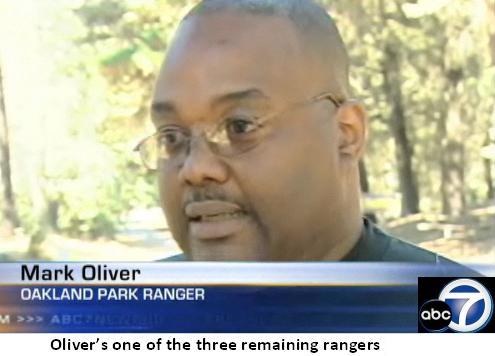
Ranger Mark Oliver is one of the endangered rangers, who’s been keeping Oakland parks safe for the past 21 years.  “That’s our primary responsibility” explained Oliver, “so that moms, kids, daddies and senior citizens, when they go out to use the parks, they can feel safe.”
The park ranger unit was founded back in 1946, and staffed at least 20 rangers just seven years ago.  Most recently, the unit had eight ranger positions and one records specialist.  With the latest budget travails, there are now three lone rangers.

According to an e-mail sent to “supporters of safe parks” this afternoon, these rangers will do the best they can with their remaining 15 shifts.  They will be working weekdays but not on Saturdays, Sundays, Holidays or night-time shifts.  If rangers are sick or on vacation, there won’t be back-ups.

Last week, I took a quick hike at Joaquin Miller Park and visited the Ranger Station.  It’s like visiting a neglected attic there, with old exhibits about Miller, and a sign saying the ranger’s office is closed.  Very sad vibe, even though I understand that staffing field offices is a luxury.

At least for Joaquin Miller Park and other heavily-used destinations, I wonder if we should develop even stronger volunteer efforts.  The Ranger Unit says they are looking for volunteers for these duties:  Citizens on Patrol, Bicycle Patrol, Mounted Patrol, Field Office Representative, and Special Events.

Is there a ranger left to organize volunteer efforts?  Try visiting the Ranger Station (map) or else calling 510-482-7888 weekdays.  We often clean up parks but don’t think much about helping with safety matters.

Montclair Equals Measure WW

The November 4th election is really important, at least in our beloved East Bay backyard.  Yes there’s a presidential race and all, but Measure WW matters directly – because it improves local parks by extending the “existing East Bay Regional Park District bond with no increase in tax rate.”

You can’t avoid the wilderness/urban interface living in Montclair, and Measure WW helps preserve more non-renewable, open spaces throughout the East Bay.  Check out this interactive map, where you can insert any address and see what projects are planned nearby.

We’re lucky to live in a bucolic outpost, with the parks right up the hill.  As quick inspiration, here are some familiar Redwood and Briones scenes by local artist David Miller.

We’re unabashedly pro-WW at Today in Montclair, aligning with all the arguments for the measure and supporting the range of land acquisition and other benefits for East Bay residents.  After all,  we’re blessed with Redwood, Sibley and Huckleberry nearby, and see them as gems.

What about the folks who say no on WWW in November?  They just received an unintended boost when the ballots forgot to print the Measure WW title and description, which is a shame.  Generally, they believe trails are mismanaged, feel they are overly grazed, and want more places to bike as well.

While some of the Park District’s trail practices or fire suppression activities might raise valid concerns, it seems like we should all agree that establishing conservation funds is a common good.  Plus it costs $10 max per $100k home value, nothing different than rates that are expiring now.

We don’t literally live in the wilderness, and are lucky to have open spaces at all.  When you fly over the hills, there’s a noticeable difference in the Bay Area versus any other major urban area – so let’s try to save the open spaces, however imperfect.

Your Hills Budget Meeting, Monday at 7pm

Before the City of Oakland makes its final budget cuts, there’s one opportunity for you to participate in the discussion.  Our city rep, Jean Quan, organized a meeting for District 4 constituents tonight at 7pm, in the Redwood Heights Recreation Center (map).

Given the Oakland budget gap, this is an important opportunity to discuss where the cuts should be and should not be made.  Among other city services, our well-loved parks and libraries are at risk – and we must provide guidance in these areas.

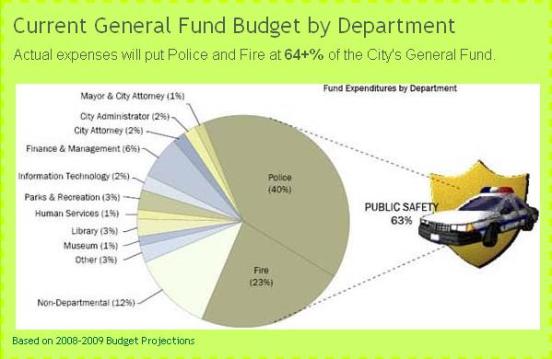
To understand the current budget, this chart (above) shows how funds are distributed to each department.  There’s not much to work with, with some 64% that gets directed to the police and fire departments.

Late last month, Oakland Mayor Ron Dellums issued a full report covering the budget and where the city recommends cutbacks.  According to the report, Dellums and his team explain that “having only $110 million in discretionary budget leaves little flexibility when attempting to eliminate a $37.4 million shortfall.”

Just like private industry, the recommendations to freeze hiring, lay off current staff, minimize salary increases, and shorten the work weeks are appropriate – if painful – steps to close the gap.

Mark Zinns, who supervises Montclair Park, confirms the cuts:  “Yes it’s true that Montclair Recreation Center and Park is facing some serious cut-backs because of the city’s financial crisis.”  He expects to shutter the Rec Center every Friday, and make cuts/layoffs to maintenance, gardening and recreation staff.

The City also plans to eliminate the remaining handful of park rangers, who specialize in park safety.  This past weekend, for example, Joaquin Miller was closed due to high winds and fire danger.  Are the replacement beat cops, who earn more than the rangers, ready to handle new assignments?

Finally, local libraries are under examination – and Montclair’s hours and programs are at risk too.  No one needs to argue about the educational resources available both online and on the shelves.  Our storybook library has been a source of pride for years, and it should stay opened six days/week.

Cutting back on parks and libraries doesn’t solve the bigger budget gap, because their numbers are quite small.  As you can see, only six percent of the budget is spent on them.  While there’s no question that some minor reductions could be made, we have to make sure that these civic resources don’t get decimated.

We live in interesting times.  Keep in mind that the WPA was busy building up these neighborhood gems during the Great Depression, and now we are thinking they are places not worthy of sufficient resources with this economic downturn.

Burglaries Way Up, And We Can Help

When the Oakland Police report that burglaries have jumped 73% in our ‘hood, we should take notice.  These break-ins have increased in the past month or two, while all other crimes have held steady.

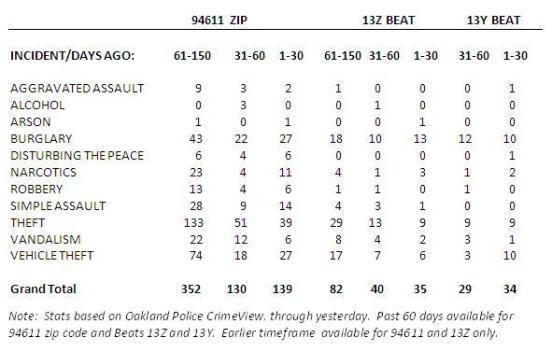
For the whole 94611 zip code, there’s no question things have gone awry.  Last time we looked, there were 43 burglaries in a three month period (early May- early August).  In the past two months, there were already 49 hits.

In Montclair’s Beat 13Z, south of Thornhill, there have been 23 burglaries in the past two months as compared to 18 during the three preceding months.  Beat 13Y, north of Thornhill, is also experiencing similar levels.  I’m not precisely sure where that 73% figure came from, but there’s no question about the trend.

While it’s unclear how many crooks are casing Montclair, they are good at what they do!  They stay under the radar and specifically enter homes to snatch easily re-sold items.  The burglars like electronics most of all, and also pick up construction materials.

Earlier this week, our police officers attended a neighborhood meeting and focused on these burglaries.  The cops haven’t received more calls, and they want us to communicate whenever we see anyone out-of-place.

Apparently post-burglary interviews sound something like this:  “Yes, I thought he looked suspicious but I didn’t want to be racist so I didn’t call.”  We seem to suffer from a bit of political correctness, and need to get over it.  If there are unfamiliar faces, then pick up the phone.

The cops may be able to connect the dots, when we provide additional eyes and ears.  Speaking of which, some neighbors do report local speeders and I recently received a fair warning from the Oakland Police.  We should be able to pay attention to other suspicious activities, too.

Which Community Programs Live?

Civic-minded Oaklanders typically support and vote for community programs that help kids, elderly and everyone in between.  This seems rather natural to do, but now our choices aren’t that cut and dry.

On the November ballot, there’s something called Measure OO, which ensures funding for kids’ after-school programs and more.  This measure effectively “earmarks” $26 million annually in the city budget.

Why Vote For Or Against OO:

Vote For: Advocates say the programs must be secured, since they help kids focus on their schooling and futures.  According to one supporter, “As someone who has worked for Oakland public after-school programs, if Measure OO doesn’t pass, we lose most of our funding.  If it passes, we will get 2.5% of the budget – but if it doesn’t pass, we lose even the 1% that we are getting now.”  (lucille.two27)

Vote Against: Opponents appreciate the programs, yet reject the budgeting tactics.  “The City Council already has extended the original funding for an additional 12 years.  Measure OO proposes to increase the funding beyond the current level, and to do so forever.  What other program is getting its budget doubled in this time of big budget cuts?”  (League of Women’s Voters)

From a financial perspective, the measure would require Oakland to allocate $26 million in perpetuity, before any other programs are budgeted.  It actually increases city funding from 2.5% to 5% of the budget.  Meanwhile, our City Council has to make 15% worth of cuts to the overall budget – so this doesn’t add up.

Hobson’s Choices:

There’s no question that other worthwhile social programs, for kids and adults, would get whittled away.  Here are likely candidates, along with their current budgets:  public libraries ($12.3m); parks & recreation programs ($14.7m); human services for families/elderly ($6.75m); and even the Oakland museum ($6.4m).

We have difficult trade-offs to consider here.  Who’s more worthy?  Kids who attend after-school programs versus others who visit local libraries?  I believe libraries provide a terrific oasis as well, including access to the internet, and friendly faces willing to help.  The same might be said for all the park programs, which appeal to kids too.

In more stable economic times, we would all jump at securing funding for community programs.  However it’s more important to maintain some flexibility and ensure the survival of other city resources, too.  This measure takes away our freedom to choose.

More Insights:  Please click on comments, discussing how Kids First programs are funded (!) without passage of Measure OO.