Village Bank Robber Returns

The Trib’s reporting that the same guy who robbed the Wells Fargo in Montclair at the end of June returned this morning for another take at the till.

OPD describes the bank robber as a black man in his late 20s or 30s with a goatee. He’s about 5 feet 9 inches tall and about 180 pounds. His signature item of clothing is a Pittsburgh Pirates baseball cap, which he was wearing during both robberies. He was last seen on Tuesday morning running down Mountain Boulevard toward Park Boulevard.

Let’s hope the third time’s not lucky.

Police and Crime Stoppers of Oakland are offering up to $5,000 in reward money for information leading to the robber’s arrest. Anyone with information may call police at 510-238-3326 or Crime Stoppers at 510-777-8572 or 510-777-3211.

Joaquin Miller Path a Go

More than 20 years ago, when City Councilwoman Jean Quan’s kids were in elementary school, Quan worried about the condition of the path that linked Joaquin Miller and Montera schools to the edge of the village at Scout Road. It’s taken some time, but this month, construction crews will finally begin repairs on a big chunk of the narrow, old and dangerous pathway.

With $140,000 from the Pay-Go Funds of Quan and former At-large Councilman Henry Chang, combined with $20,000 from community donations, the trickiest, twistiest, and steepest section of the pathway will be renovated by the time school starts at the end of the month. Sue Piper, policy analyst for Quan, said “We are dealing with the worst part.”

When this phase of construction is finished, the crosswalk will be realigned with a new landing, there will be a connection between the landing and the pathway, and a new layer of decomposed granite will rejuvenate the pathway between the landing and the cellular equipment. Oakland Unified will have to deal with the stretch between the landing and the schools. The entire length of the path between Ascot and Scout is 1,950 feet.

While this is a big step, there’s some money left over, and donations made in the next couple of weeks will help push the renovation as close to Scout Road as possible. Contributions are tax deductible.

Joaquin Miller School Pathway Project Account #P330610
c/o Sue Piper, Council District 4 Office
1 Frank H. Ogawa Plaza
Oakland, CA 94612

Note: Put Joaquin Miller School Pathway Project Account #P330610 in memo

There Goes the Neighborhood

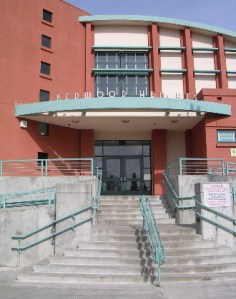
According to someone who works in Oakland Unified’s district office, parents in the Redwood Heights neighborhood are worried that property values will drop now that a standardized test cheating incident at the local elementary school has invalidated the school’s test scores for 2009-2010.

Now, there’s no question that test scores influence home prices. People pay a premium to live within Hillcrest’s boundaries and are peeved when they learn that the address doesn’t guarantee a spot in the spectacularly successful K-8 school. But is it possible that one year of no API could translate into a loss of home values in the neighborhood? We asked real estate maven Vanessa Bergmark with Red Oak Realty.

The short answer is no. However, the cheating episode at Redwood Heights School was a topic of discussion at Bergmark’s office. Would agents have to disclose the incident to buyers, an agent wondered. Bergmark’s gut told her that cheating in one classroom in one year didn’t make the cut. Although, ultimately it will be the lawyers who decide. With a school like Redwood Heights, which has great test scores, combined with the support of a committed and diverse community, the only danger is that anxious residents would convey the message that something was amiss and “create their own destiny,” said Bergmark.

Deidre Joyner, a real estate agent with Red Oak whose children are third-generation graduates of Redwood Heights School, said she hasn’t heard any of her neighbors worry about the lack of an API score for 2009-2010 influencing home prices, which she says range from $560,000 to around $750,000.

As Bergmark said, it’s all about perception. She offered the example of listings in North Oakland that fall within the borders of the city’s gang injunction. Is it a selling point if a home is in the “North Oakland Safety Zone?” It depends on how you look at it.

Telecom Towers in the Hills

A telecom company recently asked the city for permission to build three towers on Skyline Boulevard to fill in cellular “dead zones” in the Fruitvale and San Antonio neighborhoods.

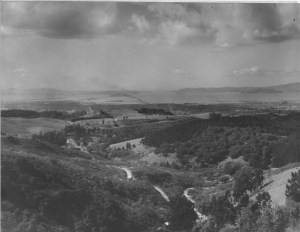
The View from Skyline Before the Age of Cell Phones

Ranging in height from 36 feet to 41 feet, it’s not likely that the towers will be built as planned. Aubrey Rose, who works for the city’s planning and zoning department, said that the site for one of the proposed towers is actually outside Oakland’s borders on unincorporated county land. Rose said that the other two towers can’t be considered for a public right of way in their current design. The second and third rules for telecom towers in the city’s planning rule book couldn’t be more clear: “Monopoles should not be sited to create visual clutter or negatively affect specific views,” and “Monopoles shall be screened from the public view wherever possible.” Rose said that the towers would have to be moved deeper into the woods, or significantly more concealed (You’ve seen the telecom towers disguised as trees) to pass muster. While the Oakland Hills aren’t the home to many towers, said Rose, the number of applications is growing.

Here are the locations for the towers:

  1. 41 feet:  Skyline Boulevard, east side of street (north of Roberts Park entrance).
  2. 36 feet:  Skyline Boulevard, south side of street (southeast of Sequoyah Bayview trailhead beyond turn-out). Withdrawn by applicant.
  3. 36 feet:  Skyline Boulevard, north side of street (adjacent to Chabot Space & Science Center street entrance).

The towers will be discussed at a meeting of the Planning Commission scheduled for August 4.

SmartMeters Arrive in Montclair

Pacific Gas and Electric has installed around 6 million of its new SmartMeters across the state. Power customers here in the Oakland Hills are now starting to get theirs.

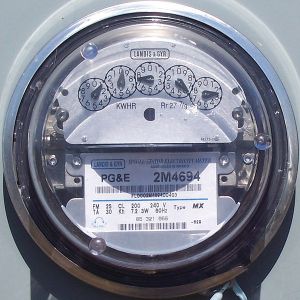
One of PG&E's Old Analog Meters

The first gripe about the new meters was that they didn’t work. The knock was that they overcharged. According to PG&E, only 0.12 percent of the SmartMeters they’ve installed are not beaming data back to the mother ship. And if that happens, the utility user actually gets a discount on the next bill. PG&E says that the SmartMeters are phase one of creating a smart power grid. When electricity usage can measured across the network in real time, the utility and its customers save energy and money. That’s the idea, anyway.

The SmartMeters are arriving in Montclair just in time for a new controversy. The East Bay Express writes that some people think the bursts of radio waves the meters transmit can harm one’s health. A bunch of Northern California towns have called for a moratorium on the SmartMeters. The Marin Independent Journal opined this week that PG&E needs to do a better job of explaining the SmartMeters. As the East Bay Express noted, PG&E won’t say how powerful the “peak pulses” on the SmartMeters actually are.

What’s been your experience with the new technology? Do you look forward to lower bills, or do you worry the SmartMeters will be hazardous to your health?