Look At Montclair’s Olden Days

Have you thumbed through some Arcadia paperbacks about Oakland before?  They publish city-wide and neighborhood books chock-full of old photos and recollections – including a great one covering our Oakland Hills.

Oakland Hills, by Erika Mailman

Author Erika Mailman penned this Oakland Hills version, starting with a chapter called “Montclair and Environs.”  We hadn’t looked at the print edition in a while, but just discovered and wanted to share this online access.

You can actually page through the complete Montclair chapter on Amazon.com, in a legible size.  It’s a great record of Montclair’s olden days, with images displaying a remote and rural-looking place.

The photos prove it!  The Medaus, who owned and farmed most of the current-day village, are posed outside their homestead.  The Hayes school is shown, followed by the Montclair firehouse which replaced it.  And the undeveloped hills are snapped, along with an observatory built to attract real estate buyers.

Anyway, it’s a pleasant surprise to see this live Montclair chapter – click to look inside.

Cyclists, Drivers Debate Canyon Protocols

Shepherd Canyon has always been a challenging place shared by homeowners, bicyclists, drivers, walkers, soccer players, dogs – you name it.

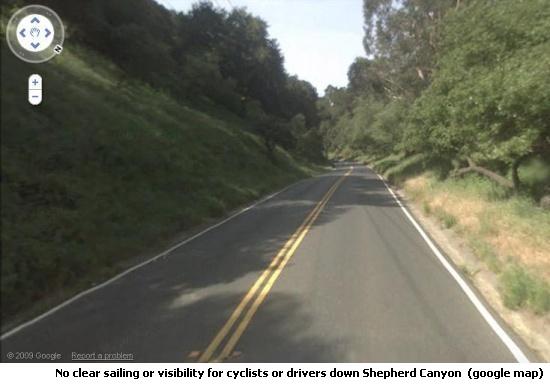
Lately there’s been plenty of discussion about the appropriate protocols among the two-wheelers and four-wheelers who share the canyon road.  The terrain translates into few shoulders, many blind spots and no easy answers.

Shepherd Canyon Road, Oakland

The debates are lengthy, and depend on behaviors of rogues and law-abiding citizens.  We think it all boils down to these five perceptions:

  1. If rider is pedaling down the road, then that’s considered legal and appropriate behavior.
  2. If cautious driver follows rider, then driver needs to take heed and not surprise ’em.
  3. If rider gets angry at driver, then it might mean rider is concerned about life and limb.
  4. If driver is barreling down the road, then driver might put the rider ahead at risk.
  5. If rider uses railroad path, then walkers with and without dogs pose mutual risks.

We believe in using a little common sense and following the rules of the road.  We live in the hills, where terrain challenges are part of the bargain.  Are we missing anything here?

Coming Out Of The Woodwork

Our little block is filled with long-time Montclarions, which we love!  We have one “mayor” who takes daily walks and just turned 83 years old.  He’s lived here for decades, and seems to know everyone.

Anyway, a neighbor got organized this year and invited fellow block dwellers to a combined Halloween and birthday celebration.  Our honored guest came with long hair and sort of resembled Keith Richards.  Other neighbors came out of the woodwork – ready to eat, drink and hang out.

Oakland Moon

It was so nice to meet and schmooze with neighbors on a beautiful Saturday night.  We sat in our alley-way and called out to the few trick-or-treating families with lots of candy offerings.  We also sugar-rushed together with all the cake, candy and marshmallows there.

Maybe this isn’t surprising, but everyone reveled in the “open secret” of the Oakland Hills.  The hassles of commuting, security concerns and natural disasters were accepted as trade-offs.  With decades of living in the Merriewood area, residents shared some memories as well:

  • Good old days – Apparently the power outages we have recently experienced were far more commonplace in the past.  The infrastructure’s never been that terrific, but hardiness gets worn like a badge of honor.
  • Beyond cats and dogs – Our own “Mr. Ed” resided in a small stable off Nottingham, and several of his horse friends also lived in the hills years ago.  There was a large menagerie of birds, along with dogs, living with the old Montclair vet (before he moved to Tasmania).
  • Weather perfection – Everyone recalled the once-in-a-lifetime snowfall, back in the 1970s, when the snow actually stuck and looked beautiful around here.  One couple starting considering retirement spots but kept discounting other locales due to, you know, weather.

As this motley crew chatted, we discovered how “place” drew us together.  We all knew the gray and white cat who visited often, and found out where he lived.  We complained about raccoons and skunks, and shared how we dealt with them.  We stared at the nearly full moon and even howled a bit at it!

We’re not complete and total strangers anymore.

Oakland, The Manufacturing City Of The West

You could say that Oakland’s searching for its next identity.  Are we aspiring to become the Brooklyn or Amsterdam of the West?  We have some momentum in these directions.  While the jury’s still out, one thing we know is that our old, heavy manufacturing glory days are behind us.

Nearly a hundred years ago, Oaklanders were actively promoting their industrial charms and grasping for that manufacturing brass ring.  We recently unearthed a 1920 publication that’s meant to lure more business to Greater Oakland – and is called Oakland, The Manufacturing City of the West.

Oakland Metro - Intro

Oakland Boosters In Full Swing

Current Oakland boosters might recognize this kind of hard-sell pitch, complete with bragging rights about our perfect weather.  Though we don’t believe you need scientists to “state that 59 degrees marks perfection.”

The grandiose language reflects a different time, though.  Come join “the industrial center of a State larger than the Kingdom of Italy.”  Come join a “city of world possibilities, a city of leadership and service – a city of destiny.”  These declarations are a bit much!

Oakland Metro - Products

Big-Time Manufacturing Here

By 1920, there were so many different goods manufactured here.  We knew about the food and shipbuilding businesses, but were surprised to learn that artificial limbs, violins, washing machines and adding machines also came from local factories.  It’s hard to imagine that 18,000 products were manufactured in 2,000 industrial plants.

War-time shipbuilding became a major source of employment and the Moore Company loomed large.  Others like Bethlehem Steel showed up for a short time as well.  But Moore had staying power by extending its tendrils everywhere and, between wars, firing up ancillary businesses to support building construction.
Moore - Paramount Balcony

The Manufacturing Legacy

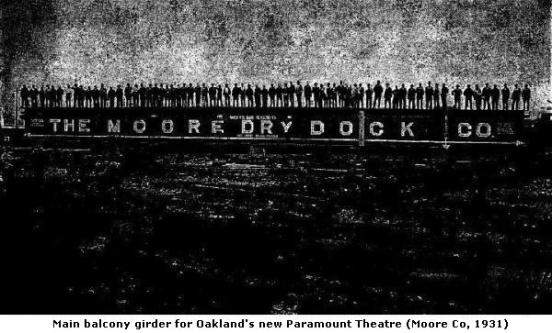
Moore always commemorated their projects with photographs of employees and other VIPs.  My favorite image is their huge steel girder (above), ready for the Paramount Theatre balcony.  When the girder was manufactured in 1931, Moore claimed it was the heaviest and largest piece ever built on the West Coast:  105 tons and 120 x 9.5 feet.  Some eighty years later, that balcony continues to support theater-goers.

Oakland’s manufacturing heyday is long gone, and those 2,000 plants have vanished without much trace.  Production and transportation don’t have to be in the same place anymore.  Our 2009 aspirations aren’t exactly clear, but it’s probably a good thing to diversify – get known for some things, get other things fixed.

More info:  Thanks to the National Park Service’s Maritime Library.  After I searched their old-fashioned card catalog, the librarians delivered materials and also gave permission to xerox and share images online.

When Yusuf Ran A Bakery

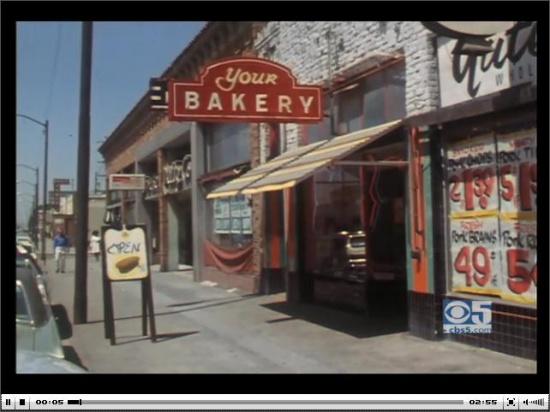
There was a time when Yusuf Bey opened an organic bakery, and he seemed quite proud of the new place.  Take a look at nattily-dressed Bey, who’s talking up his baked goods to KPIX’s Belva Davis in this 1971 archival footage.

“Most organic foods don’t taste too good even though they’re good for you,” admitted Bey.  After experimenting and tinkering with recipes, the bakery was able to offer good-tasting items – like a honey-prune cake!

KPIX Meets Yusuf Bey, 1971

Most of the video followed bakery workers as they prepared or packaged breads, and generally tried to ignore the camera.  Then the taping wrapped with Belva Davis reporting about the three daily shifts of workers, as she signed off for Eyewitness News.

Your Black Muslim Bakery seemed like an innocent place, in a more innocent time.  It was a legitimate business back then, with organic ambitions that adhered to Muslim dictates.

Who could have possibly foreseen what would happen later, as Bey was accused of rape on multiple counts?  Or what happened as subsequent generations took over, and violent crimes multiplied?  That’s history we won’t forget.

Kudos to the San Francisco Bay Area Archive, which has been digitizing 100 hours of more than 4,000 locally-filmed hours in their collection.  Check out what’s already accessible, as it’s fascinating stuff.