What East Bay Winter Looks Like

Today, we were walking in the hills and experienced the post-rain mists and smells.

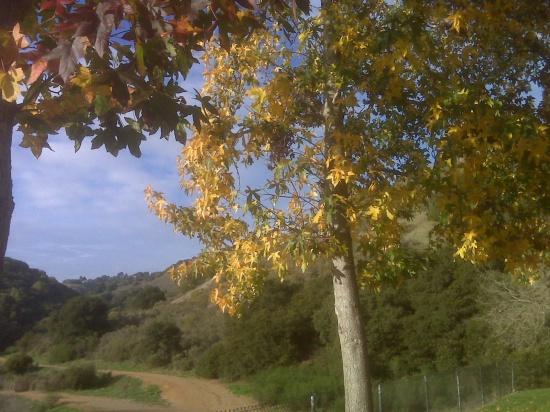
There’s special beauty in the East Bay winter, a sparse and somewhat dormant period before full greenery bursts forth.  We noticed a few fall-like colors and, if you suspend reality, some winter-like whites.

This afternoon, we actually found trees with yellow, orange and red leaves!  While this was year-end, the colors screamed fall foliage – though you did have to search for these deciduous trees.

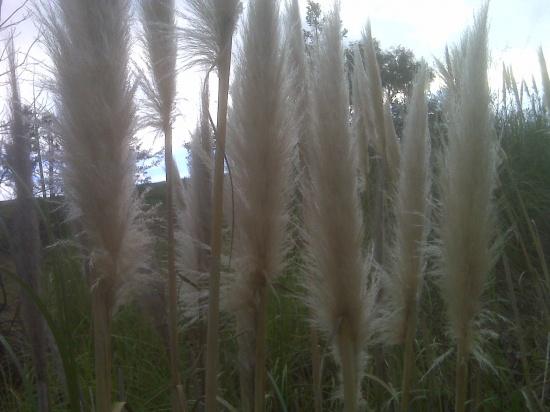
The winter-whites were everywhere, including reedy plants strutting their stuff.  By squinting hard, these feathery plants almost seemed like cast-offs from colossal birds which had migrated overhead.

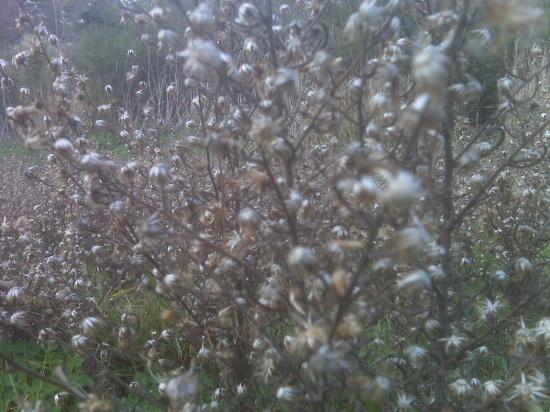
White brush was plentiful in the hills, too.  When some winds picked up, this brush even looked like a snowstorm in progress.  (Remember, we’re suspending reality here.)

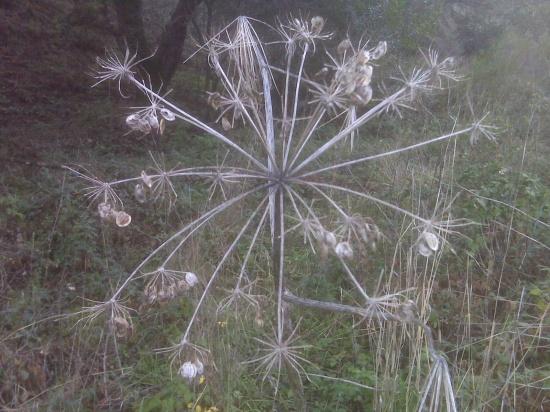
We also discovered a bereft, architectural plant and cast it as our “under-the-microscope” snowflake.  Hey, that’s the best we could do without the real stuff outside.

So today’s winter walk in the hills, around Leona Canyon, boiled down to the little stuff which caught our eye.  The cold, wet and tamped-down environment was beautiful – all courtesy of Ma Nature.

Happy Holidays In Bloom

Especially as we sat and listened to the rest of the country’s weather woes, complete with white-outs and travel disasters, we’re very appreciative of this glorious Christmas Day.

We wandered around outside and generally basked in our amazing weather today.  The skies were blue and windless, without any real nip in the air.

Looking a little more closely, the winter flowers were starting to emerge.  Today, we noticed the flowering camellias for the first time.  Here’s a bunch that already bloomed.

Meanwhile, the citrus were doing a-okay.  We thought the fruit might not make it, due to freezing weather this month.  But the citrus didn’t appear to suffer.

There’s no climate complaining here.  Yet it’s too bad that wood-burning fires were verboten, courtesy of today’s Spare The Air Day.  We just checked out the classic Yule Log TV, on KOFY 20, for a good laugh instead.

Anyway, we hope you had a great holiday in bloom.

Top-Ten Montclair Rat Tips

Normally we keep our rat relationships under wraps.  Anyone who has endured the rat-in-residence gets challenged and frustrated by this smart visitor:  Will he leave?  Will he die here?  And what do we do?

For a couple months, our own “Mickey” would pitter-patter all night long.  Eventually he passed away, replaced by “Minnie” shortly thereafter.  While it’s been quiet here, other Montclarions aren’t that fortunate.

Recently, a handful of neighbors shared rat travails on the Montclair SIC message board.  We decided it would be useful to pass along their advice, summarized in these Top-Ten Montclair Rat Tips:

1.   Call Rat Patrol

“After being awakened at night several times, I paid the Rat Patrol to come out, plug the holes and set traps in both my crawl space and in the attic.  He came back a few times to check things.  It’s been several months and I’ve had no rats ‘inside.’  He has a two-year warranty.”

2.   Use The D-Con

“I used to use D-Con when we had rats or mice, but our rats (one each time, two separate occasions) liked it so much here that they didn’t leave in search of water (it makes them thirsty) as they are supposed to – oh, no, they died inside the wall, and do they ever stink!”

3.   Welcome Flies

“Now I know what flies are for:  the maggots consume all the flesh, and then the smell goes away.  But it was kind of gross having to get rid of the flies in the stairwell with a vacuum, and yes, there were that many.”

4.   Watch The Pets

“There is another concern about using D-Con, or any poison.  If the rat, mouse, gopher, whatever, goes outside to die, it may be eaten by someone’s cat or dog.  Then that animal either gets very sick, or dies.”

5.   Try Dry Ice

“Get dry ice and put it in their burrows to suffocate them and the dry ice will dissipate without danger to any other animals.  Dry ice is heavier than air and will push out the oxygen.  When caught in a high CO2 atmosphere, they just pass out and die.”

6.   Engage Your Traps

“We do the best we can to keep them out, but they still manage to sneak in every now and then.  We keep a trap permanently set in our crawl space and catch one every couple of weeks.”  (Some neighbors use special electronic traps.)

7.   Feed Birds, Not Rats

“I too have rats in my basement, especially when I was feeding my birds.  Now I try to feed them on demand and do not have any seed out at night which the rats love.”

8.   Honor Birds Of Prey

“Also, we have lots of hawks/birds of prey around here who will eat rats.  It’s bad enough that a bunch of punk kids up on Magellan shot and killed a resident Red Shoulder Hawk last year.”

9.   Control The Plants

“I also have ivy and I have black berry.”  One possibility is to keep these plants under control, as they attract vermin visits.

10.  Plug With Abandon

“The most important thing, as others have said, is seal up all holes.  There is a great fluffy spray just like shaving cream and that is great for plugging up plumbing holes, etc.”

So what’s missing? We thought that feline ownership would surely make the list.  After all, cats are programmed to pounce on our favorite vermin and present them as gifts.  While some creatures follow their instincts more than others, any rat-catcher goes a long way.  Natch, that kitty is a commitment.
Save Chabot’s Pallid Manzanitas

Did you know we live cheek and jowl with pallid manzanitas, a threatened plant species?  These shrubs, which only live in the Diablo Range, have been officially protected by the Federal Fish and Wildlife Service.

The two major populations grow at Huckleberry Preserve and Sobrante Ridge.  Some eleven smaller populations have also been documented, including a dwindling group outside Chabot Space & Science Center.  Years ago, the Chabot team agreed to take responsibility for these guys.

Unfortunately, Chabot’s manzanitas have seen far better days.  Ralph Kanz, an Oakland-based conservationist, paid a visit to this nearby population last Thursday and sent a note to the Center’s Executive Director/CEO afterward:

Mr.  Zwissler,

Earlier today I checked on the pallid manzanita at the Chabot site and found only six surviving individuals.  Surveys in 1994 documented 21 plants on the site.  The EIR approved for the project in 1995 required the preparation of a management plan for pallid manzanita before issuance of a grading permit.  The management plan, intended to provide for the on site protection of the species, has yet to be completed and over 70 percent of the plants on the site have died.  As you know this presents a threat not only to this particular population, but to the species as a whole.  Because this appears to be a naturally occurring population, the loss of so many plants threatens the genetic diversity of the on-site population.

At present, I would only consider two of the six plants to be in anything approaching a healthy condition.  Today I found one plant that appears to have been recently vandalized.  The damage could likely lead to the loss of the plant leaving only five surviving plants.  Based on past observations I believe one of the plants will die in the next year and that would bring us to four survivors.  Another had a dead tree fall on it recently and its fate is uncertain. That could reduce the population to three, a decline of 86 percent from the pre-project population.  In the 14 years since the City of Oakland approved the Chabot project, there has been no regeneration of the population.

I first wrote to Dick Spees about this issue in 2000.  I attended a meeting at Chabot in July 2005 to discuss the issue and try to help this imperiled species.  Many of us who care about seeing the species preserved and want to contribute assistance have not been kept up to date on what is occurring on the site.  If the mitigation measures agreed to by Chabot 14 years ago are not implemented very quickly there will no longer be a genetically viable population on the site.

What are Chabot’s plans?

– Ralph Kanz

Chabot is a top-notch observatory and educational destination, which mostly looks at skies above rather than grounds below.  However the place does project a conservation ethic, as played out in their outdoors programming and even the gift store!

Based on earlier commitments, the Chabot brass should step up to the plate and help save their remaining handful of pallid manzanitas – or these indigenous shrubs will likely vanish from the area soon.

December 22nd Update:   There’s good news from Kimra McAfee, executive director of Friends of Sausal Creek.  She reports the pallid manzanita plan has been finalized by Chabot, along with a memo issued by CA Fish & Game.  Long story short?  There’s a permit in place, and the Friends will begin working on restoration and enhancement.  Chabot will also remove that dead tree imperiling a shrub, early next year.

Official City Fish Campaign

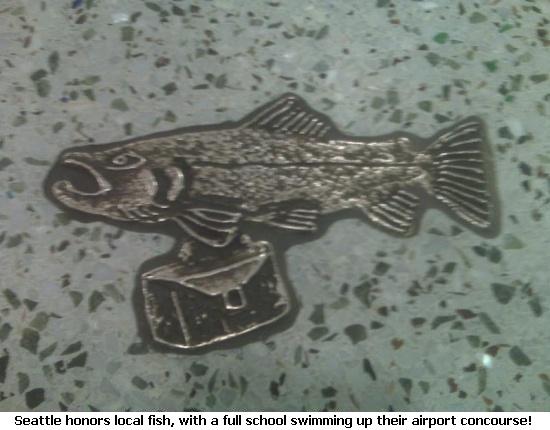
We simply cannot ignore our city’s legacy anymore.  As you may know, rainbow trout were discovered in Redwood Regional Park, back in 1855.  While this fact is recognized in historical and environmental circles, we don’t put the trout in their appropriate position of honor.

Due to watershed improvements, from tireless efforts by Friends of Sausal Creek and other groups, the trout find their way into city streams these days.  So the timing seems right for bullhorning this all-important trivia – and all trout fishers in America should know about Oakland.

Let’s declare the rainbow trout as the official fish of Oakland. The species should be placed in a position of honor, right along with Jack London and Oak trees.  We might get better known for our unique urban-rural mix within city limits, and the highly-regarded rainbows seem like a great way to improve perceptions of Oakland.

W.P. Gibbons first identified trout fished from Redwood Creek, then called San Leandro Creek.  Today the area is memorialized in Redwood Regional Park, where you’ll find a stone monument and plaque describing California Historical Landmark No. 970:

Rainbow Trout Species Identified – The naming of the Rainbow Trout species was based on fish taken from the San Leandro Creek drainage.  In 1855, Dr. W. P. Gibbons, founder of the California Academy of Sciences, was given three specimens obtained from the creek.  He described and assigned them the scientific name Salmo iridia.  Rainbow Trout are now worldwide in distribution and are a highly prized game fish.

There are many ways to honor the rainbows, starting with the City Council declaring an official fish status.  Then the fish might appear in official descriptions about our city.  There also could be some memorial in the downtown area.

We’re not aiming to become a fly-fishing destination (!) but this claim-to-fame birthplace surely will grab the attention of visitors.  A couple folks might even come and pay homage to the rainbows at Redwood Regional Park, too.

Now this something with fins (oops, legs).  Anyone want to pick up the campaign and make it happen?