Yes, Goats Are Back!

Sure enough, our beloved goats have returned from their off-season stomping grounds.  We spotted the billies roaming the lower reaches of Hiller Highlands this afternoon,  making rapid progress on a now-mowed patch.  You might catch a glimpse yourself, while looping from 24 West to 13 South.

With brush growing quickly around here, these goats contribute to annual fire-prevention efforts.  The East Bay Regional Park District has scheduled two major grazings this year – first in Claremont Canyon from May 23rd – June 3rd, and then at Redwood Regional Park from July 19th – August 4th.

To prepare for fire season, the goats won’t have to operate alone.  The Park District already has cut down brush and intends to oversee controlled burns along with local fire officials.  As soon as calm weather prevails, these burns will take place in Gwinn Canyon, a high-risk area flanking Claremont Canyon.  So don’t be alarmed if you see a little weekday smoke in the hills.

Within a couple weeks, Montclarions will need to start working as well.  It’s almost time to get out your machetes and slay the greenery growing too closely to your homes.  While still a whisper, there will be rallying cries:  defensible space! defensible space! defensible space!

April 20th Update:  The NY Times Bay Area blog reported about local goats, since our Oakland City Council is deliberating on whether to approve (or not approve) $250k for goat grazing on city-owned lands.

Another Perfect Day In Nearby Hills

Our East Bay springtime is ephemeral and utterly amazing, and the emerald greens, flowers, flowing waters, and overall gestalt are an antidote to our daily responsibilities.  This weekend, we drove 45 minutes to the Sunol Regional Wilderness and it delivered on all spring fronts.

The Waters

Our travels took us to “Little Yosemite,” and this gorge definitely reminded us of that little national park on a 1:500 scale.  If you haven’t been to Sunol before, then you must put this on your to-do list.  The water shots, above, are low resolution video freeze-frames we took by mobile phone.

It’s quite easy to get there!  The walk down Camp Ohlone Road lasted around 15-45 minutes, depending on your propulsion speed.  There were a couple dozen walkers and families with the same idea, and plenty of room for everyone.

As you parallel Alameda Creek, it eventually transitions into a beautiful, rocky gorge that continues for a good distance.  We climbed down and around the rocks, finding suitable perches.  Then we simply sat quietly, listening and letting the river run.

The Hills

Eventually the emerald hills and comfortable weather beckoned, and we decided to head up a couple thousand feet through the adjacent Ohlone Regional Wilderness.  This part of the visit is for heartier hikers, and you need to decide how many vertical feet and miles to travel.

We headed straight up, down and across the ridges on this picture-perfect weekend.  With a single, cross-country trail running through Ohlone, views like the one snapped above reveal San Francisco Water District no-man’s land.  At this point, we were a couple miles from Rose Peak, known as Alameda County’s high point.

En route, we noticed prodigious white, purple, and yellow wildflower carpets which won’t be around much longer.  That feeling of spring, with few signs of civilization in the watershed, had worked liked a charm.  Ohlone and Sunol both hit the spot – and felt just right on this weekend celebrating Earth Day.

Ode To Anthony Chabot Park

Oakland benefactor Anthony Chabot has left plenty of legacies behind, especially in harnessing and creating metropolitan water systems.  Of course, everywhere you look around our city there’s a Chabot something or other.

We visited the Anthony Chabot Park to see how spring was progressing there.  Don’t confuse this Park with the contiguous Lake Chabot Park, which encircles the large boating reservoir.  These two East Bay Regional Parks bear his name, and the one we visited sits between the Lake and Redwood Regional Park.  Anyway, we drove up to Skyline Drive and took off.

Ah, perfect greens abounded on this wet April day!  In this view, you see the urban and wilderness divide.  Anthony Chabot Park is in front, while Chabot Golf Course appears in the valley below.  Beyond these largest hills, there’s a gray-colored ridge fully occupied by humanity – it’s Hayward, the CSU-East Bay Campus and points south.

In keeping with the original water reservoir roots of the area, there’s plenty of East Bay Municipal Utility District (EBMUD)  land located east of these two parks as well.  The Upper San Leandro Reservoir remains off-limits to walkers, hikers and bicyclers but peeks out from the dead-end Coffeeberry Trail, at Anthony Chabot Park.  You can feel remote, right here.

When chatting with avid local park users, you often hear encouragements of “spring wildflowers.”  So we dutifully set out and discovered tiny blue flowers and orange poppies, which were identical to ones spotted around Montclair.  Maybe you have to be more tuned-in, persistent or lucky during the hunt.

Pay dirt!  This time, we also noticed alpine-looking flowers growing near a rocky outcropping and finally understood the enthusiasm.  These beautiful purples and yellows deserved more than our quick digital proof statement.  Call in Monet or some plein-air artists immediately.

More info:  Anthony Chabot Park is surprisingly close to Montclair.  We suggest taking 580 South to Keller Ave. exit.  Make a left and head uphill on Keller.  Turn right on Skyline Blvd.  Park at the Clyde Woolridge Staging Area, across from Grass Valley Road.  Check out park maps here, including high-level, northern section and southern section versions.

Looking Up At Our Sky Today

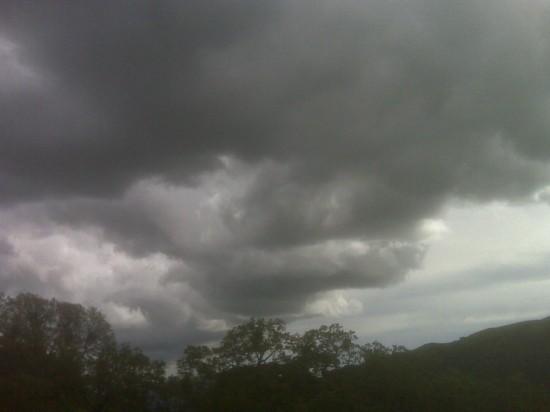
This late winter weather is fascinating!  We’re weather obsessed the past couple days with the wild, mountain-like storms hitting normally weather-perfect Oakland.  Today, the winds and sky were absolutely beautiful, right before the rains arrived this afternoon.

In this view of the thunder clouds, it almost felt like we were in Kansas and awaiting some kind of funnel cloud to drop down.  The winds were very strong and the clouds were moving so quickly.

Not that we’re going to become storm-chasers, but it was [pick your superlative] to witness this intensity outside – and pretty harmless around here.

How To Check Power Outages

When will Mother Nature strike again, putting us in the dark?  It’s hard to say during this storm-laden week.  Your faithful Montclair blogger can always tell when there have been recent power outages, based on what you’re searching to get here!  We think it’s time to reveal the best official place to check:  PG&E itself.

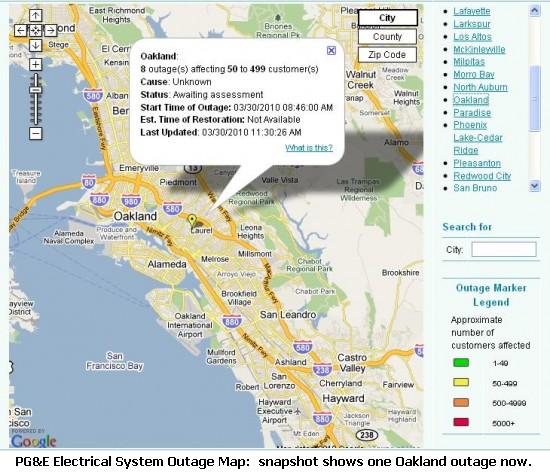
Today all is calm in Oakland, based on the map status a few minutes ago.  In this snapshot below, you can see eight outages reported with the cause unknown.  We assume the repairs are underway, and perhaps these residents near the Laurel won’t even know it happened – save the clocks gone awry.

When you visit PG&E’s status map, you’re able to track the Utility’s entire 70,000 square mile service area.  No matter what, there are always outages scattered across such a large footprint.  You would go ahead and select a city (Oakland) and, as needed, drill down to zip code (94611) to see what’s happening right now.

Of course, an online source has some natural flaws:  when the power’s out, it may be tough to go online.  With fingers crossed, we sometimes have cell phone service and hit the interweb to check outage times, causes, homes impacted and updates.  Pretty cool!

If you don’t have online access due to the outage,  then you may still reach PG&E the old fashioned way – by land-line phones operating off the grid.  Remember to have a telephone directly plugged in,  and not all hooked up to remote handsets depending on electricity.

PG&E has two toll-free numbers available to report any outage (800-743-5002) or to ask questions about outages (800-743-5000).  Keep ’em handy, especially during this stormy week.